
Balance Tests: What Gets Measured? How Can it Help Me?
I’m writing about balance testing lately, and think you may be asking, “Cara, why should I care?”
Using my own test results as examples, I’ll go over each test to answer the following questions:
- What about balance is being tested?
- And, how can this information be helpful?
I’m fascinated by the variation in balance skills I’ve seen in people thus far and would like to do more testing. A wider range of testing will likely surface new correlations and insights, boosting your confidence with being active.
If you want to help contribute to the data, new dates/times are available for free balance testing. The details and sign-up link is below. I appreciate the help!
 Behind the Scenes: About the Balance Testing
What is the big deal about balance testing?
When it comes to helping clients identify and overcome balance challenges, I find numbers tell a story which is often more tangible and actionable.
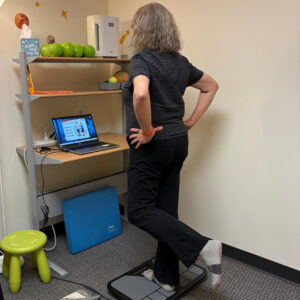
Our new Balance Tracking System (BTS) provides research-grade analytics for a number of aspects of balance.
The Bridging® Technique originated from my work with balance 20+ years ago. The ability to add numbers to years of practical experience and knowledge is proving insightful to this engineer at heart. (My earlier education and background is power systems engineering.)
A key feature of the Bridging Technique is analysis, which helps you and us figure out the correct problem to solve. Balance exercises are not necessarily the solution to all aspects of balance concerns. Some of the causes for these concerns are ideal for a targeted session or two of Bridging resets. These are often related to a past injury or medical intervention.
What insights into balance can be tested?
There are six basic tests which can be used to provide insights into different reasons you may not feel steady, or feel unsettled after a medical intervention, injury, or medication change.
To build familiarity with the test device, I tested my own balance. I have visual issues (strabismus and no depth perception) which lowered my scores when visual sensory feedback was a factor. The difference made sense. I also found my injury from last year is still affecting me.
Here are the six tests, my results, and the insights they can provide.
 Weight Distribution Test
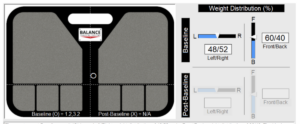
This test shows how your body moves around while it works to keep you standing still. The information provides an initial insight regarding overall postural control, such as leaning to one side or forward/back.
My results show I stand pitched forward and to the right.
The visual imbalance I have likely factors into this weight shift. Yes, this makes sense since my shoes wear in that pattern too.
 Limits of Stability (Weight Shifting)
This test reminds me of the old Wii-Fit games. You stand on the test device and shift around to draw a rectangle on the screen. The size and position of the rectangle provide insights on how your body is able to control movement away from center.
My ability to shift around while maintaining control is quite good. I am better to the front, but leaning backward is not easy nor does it feel secure.
The way people use their bodies to shift tells HOW they are able to coordinate in each of the directions.The observations are clues for our Bridging work together.
The following four are timed tests ranging from 10-20 seconds per test segment. They can be repeated in the future and compared to an initial baseline.
Overall, these tests are proving insightful for post-injury or surgery to see how balance was impacted.
 Balance and Fall Risk
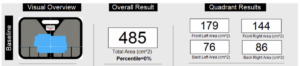
This test, done with eyes closed, tracks the centimeters of your body’s movement while appearing to be still. The larger the movement, the greater the fall risk.
Thankfully, my fall risk is very low. I’ll take it!
(But gosh, I was moving around a lot! 25cm!)
If your fall risk is higher, it is a signal to get serious about various aspects of exercise to improve balance, as well as taking measures to fall-proof your living situation.
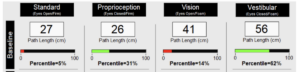 Modified Clinical Test of Sensory Integration and Balance (mCTSIB)
There are four parts to this test which provide insight into which sensory system may be factoring into your sense of unsteadiness. The sensory systems’ contribution is teased apart by modifying visual (eyes open/closed) and proprioception (foam pad under foot) sensory feedback.
Again, my visual deficit shows up, and clearly throws off my balance. Apparently, I function better with my eyes closed or in low light. How fitting that my work space is often dimly lit!
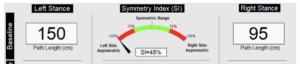 Single Leg Balance
This test is what often comes to mind with the term balance. You stand on each foot for 20 seconds and compare the steadiness between each. (This test is challenging and I use it selectively.)
When I fell last year, my left knee took a good hit. The effect of that impact was also evident in this test result since my left leg balance was much worse.
However, this is 100% something a Bridging® session can focus on improving. Adding it to my list!
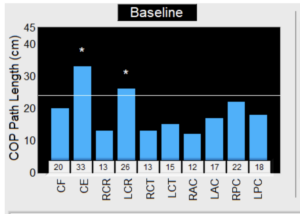 Cervical Challenge Test
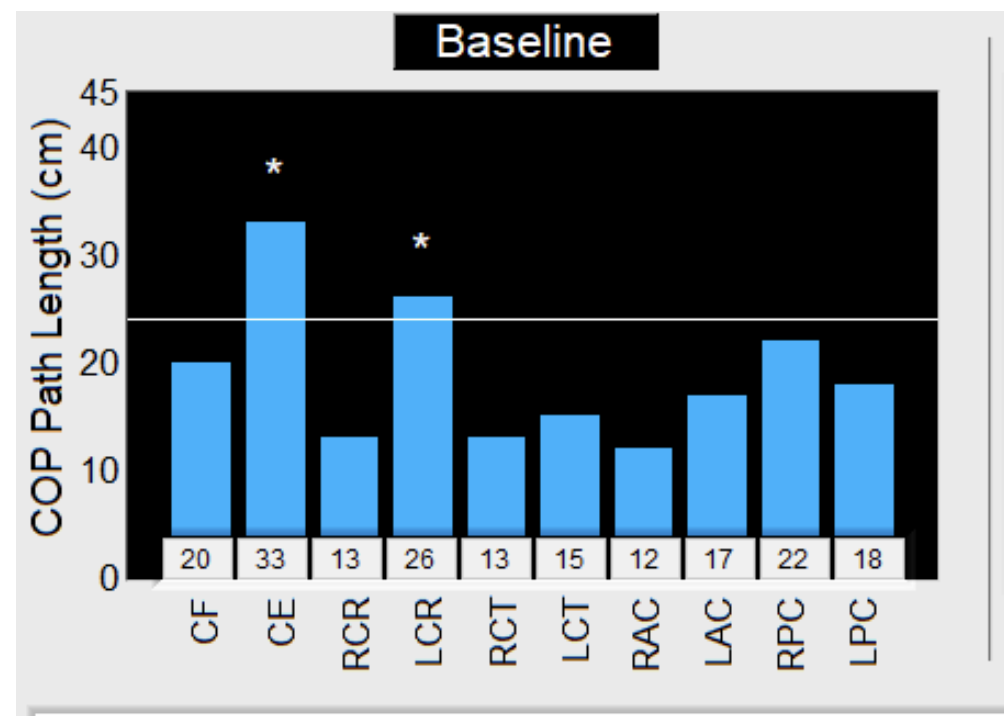
This test is insightful following a head injury, concussion, or even dental work. The premise is to test balance with your head in a variety of angles to see which throw you off-kilter.
For this test a person stands with eyes closed for a period of 10 seconds with up to 10 different head positions.
My test shows that extending my head backwards throws off my balance. This means that activities looking up need to be done cautiously. No tennis for me!
What Are the Practical Takeaways from My Test Results?
Bottom line for me is the following:
- My poor vision really does impact my everyday balance. I can work on this with exercises involving focus together with movement.
- The injury to my left knee still is still impacting my balance. This is the perfect insight to help focus some future Bridging muscle reset work.
- Tilting my head back can throw me off balance. For the time being, this insight is a guide for me to be more cautious in these situations.
Yes, I expect the application of targeted Bridging® muscle resets will fundamentally improve this unsteadiness. Stay tuned! In the months to come, I’ll retest to see how it changes.
Interested in Testing Your Balance? More options now available
Balance Testing: Can I Test Yours?
Dates: Wednesday July 1 and July 29
Times: From 1 to 3:30p CT
Time Needed: 30 minutes
Location: our Northbrook, IL office
Cost: $0
You will receive a pdf report emailed following the test.
Sign up for your 30 min time at this link.
(You do not need to be a Bridging client to sign up.)
If you’re interested but not able to schedule one of these times, here is a waitlist for a future date.
If you’d like a more personal evaluation and recommendations, the balance testing can be included as part of your session time. Let us know in the appointment note option of your interest to make sure we are set-up for you.