
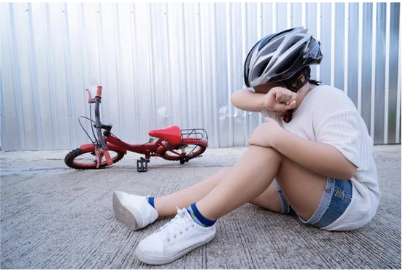
When Kids Fall … Sometimes They Don’t Fully Bounce Back
Quick Overview: Part 3 in a series on how a fall affects movement
This series explores how a fall can quietly affect your ability to move. In this series, we’re diving into what most recovery models completely miss:
- How falling creates hidden disruptions in your movement system (Link to part 1.)
- The physics of impact — and how your body absorbs force (Link to part 2.)
- Why a fall in childhood has unique implications
- What you can do to help get your body back together
 Welcome! I take an engineering-based look at how muscles work together as a system for movement and coordination.
You have pain or balance concerns when muscles don’t coordinate and it turns out there is usually a trauma, illness, or development at the root. It’s the kind of thing your doctor likely didn’t study — but it explains a lot about what you’re experiencing.
Some insights from Becki Logan, Bridging Specialist
 Thinking Differently About Kids
Generally we expect kids to fall as part of playing and being a kid. When they fall, a kiss and some ice usually help it feel better. Sometimes it doesn’t.
Although falling can be bad, remember, kids need risk. The tree climbing, swinging, racing, and roughhousing are GOOD for development. They all serve a role in building:
- Confidence
- Strength
- Body awareness
- Personal boundaries
Although kids are more resilient in many respects, there are some unique considerations to why and how a fall may be affecting them. The signs may not be obvious either!
These range from a derailed developmental step to uncharacteristic behavior. A lingering activity avoidance can also be a signal that the body may need help re-centering and re-coordinating. That’s where a Bridging® reset can make a big difference.
The Over-looked Effect of Falls with Children
Falling is part of childhood. Running, climbing, spinning, testing limits — kids are wired to move and take risks. Most of the time they pop back up and keep going.
But sometimes a fall leaves invisible effects that don’t look like injury. Instead, they show up as changes in:
- Coordination
- Sensory processing
- Self-regulation
After a fall, the body may not be as centered and organized as it was before. That means your child may be working harder just to stay balanced — leaving less energy for learning, playing, and emotional control.
🧩 Think Jenga
Picture a Jenga tower.
Each fall is like a bump to the tower. One bump may not matter much … but repeated bumps make the structure less stable and harder to hold together.
Kids are resilient — until the system has to compensate too much.
The following are some of the outward ways a fall may be impacting your child.
Coordination Seems “Off”
 You might notice your child:
- Tripping more often
- Avoiding climbing or playground equipment they used to love
- Looking suddenly awkward or less athletic
- Struggling to learn new motor skills
A fall can disrupt how the core, head, and limb muscles coordinate. Kids keep moving, but the timing between body parts may be off.
This isn’t laziness or lack of effort. It’s a coordination glitch.
Sensory Sensitivity Increases
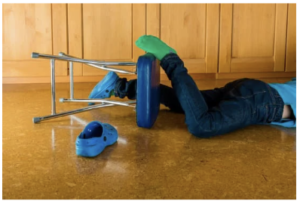 Your child may become:
- More sensitive to noise, touch, or movement
- Easily overwhelmed in busy environments
- More reactive or emotionally “on edge”
Fun fact: Children and adults have the same number of neurological receptors. Because kids are smaller, a fall can stimulate a larger proportion of their nervous system. A bigger sensory “shock wave” travels through a smaller body.
Regulation Becomes Harder
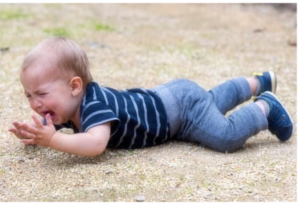 After a fall, your child may have:
- Trouble calming down
- More meltdowns or big emotions
- Difficulty focusing
- Restless sleep
If the body feels unstable or off-center, the nervous system stays stuck in fight or flight survival mode. A system that can’t fully settle, makes calming down hard.
Kids’ Falling Has a Different Impact, Literally!
Growing Bodies Add Another Layer of Complexity to the After-effects
Kids’ bodies are constantly recalibrating how they move:
- Bigger feet change balance
- Longer arms change spatial awareness
- Growth spurts change how they fit through spaces
They’re already adapting daily. A fall can throw off this recalibration process, making them seem clumsy or unsure for longer than expected.
When There’s a Broken Bone
Children’s bones are “greenstick” — bendy and flexible like a young tree branch. If a fall is strong enough to break one, the force was significant.
That impact can also:
- Shift joint mechanics
- Disrupt breathing patterns
- Turn off coordination between muscle groups
Yes, kids heal quickly. But healing bone is not the same as resetting their whole-body coordination.
Smaller Body = Broader Impact
The smaller body of a child is not as able to absorb the force of a fall as easily as we might think. There is less surface area so the force affects a larger percentage of their body. This is similar to the pressure of a stiletto heel being more damaging to a floor than a wider heel.
The effects observed later are also different than with adults. Any given fall into a rock, a step, or other hard surface while playing can affect:
- Breathing (getting “the wind knocked out”)
- Rib or shoulder mechanics
- Core coordination
More than one area is often disrupted — even if only one area hurts.