
Balance and 3 Sensory Systems — Bill’s Story
Over the past two weeks I’ve been testing the balance of volunteers to put our new Balance Tracking System device to work (read more here). What’s been fascinating is two-fold:
First, each person tested actually had an accurate sense of what made them feel better or worse. We were able to validate this intuition and determine specific factors contributing to feeling off-balance.
Secondly, we uncovered a surprise for many in how they were unable to maintain balance standing on a soft surface with their eyes closed. This was due to poor proprioceptive sensory feedback from their lower body (more about sensory feedback below).
What the Insights Mean for You
Details matter. Your balance can be fine in some scenarios and not fine in others. There are specific attributes of balance which align to ‘not fine.’ The testing teases out specific aspects of balance challenges so we could provide specific advice for actions to feel more secure.
TRUST your gut! You likely know when your balance is questionable. You likely have figured out what makes you feel safer.
If you’re wondering what kinds of insights, here is one example. I’ll share more in future weeks.
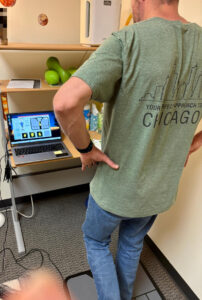 Bill’s Balance After a Stroke
Bill had a stroke many years ago. After years of exercises, he has minimal outward effects.
His favorite activity is running although recently he’s been affected by recurring muscle stress.
Using the Balance Tracking System, we took a look at how his balance differed between right and left legs, and how his running shoe selection may change his balance.
One insight: firm soled shoes were better. His proprioceptive sensory feedback (where we are in space) was significantly limited with a soft surface underfoot, similar to wearing highly cushioned shoes.
Shoes which provide the maximum sensory feedback for his brain to react are helpful for his balance reactions. This verified why he felt his running was better in shoes which allow his feet to feel and react to the ground.
From a Bridging® reset perspective, the data implies there is room for improvement to neuromuscular system function so his proprioceptive sensory system is able to provide better feedback from his feet and legs.
Having this balance data is an objective way to measure how he is progressing.
 Balance Sensory System Basics
By definition, physical balance is the control of your center of gravity, while at rest and while moving.
How do we stay balanced while still or moving?
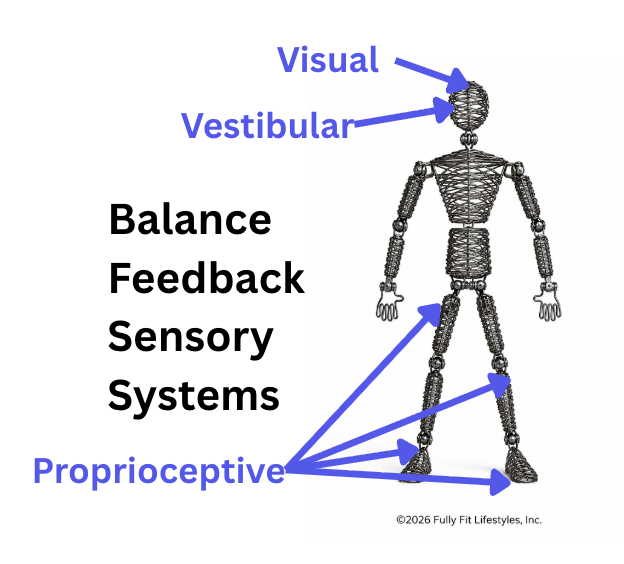
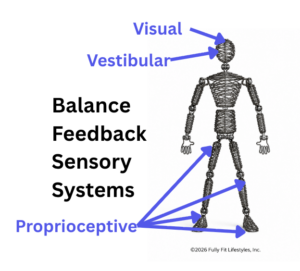
Our brain reacts to sensory feedback from the body. This feedback comes from three types of sensory system signals: eyes (visual), inner ear (vestibular), and body (proprioceptive.)
The eyes provide anticipatory information about what is coming up next, while our ears and body tell the brain what is happening in real time. These three streams of data are analyzed and directives for correction are sent out to the muscles to change course.
In short, the information from these three systems allows the brain to triangulate where our bodies are in space related to how we are moving and adjust our movement to stay safe.
Here is a bit more detail about each system’s role in balance, why it may be suboptimal, and how that causes you to feel.
Visual Feedback
 This system is generally straightforward. You see where you are in space and can react to what your visual system says is coming up.
With poor visual feedback, the sensory input from the body becomes more important to react to changes in the environment. This is why balance can be challenging when your eyes are closed, or in the dark.
Common causes for poor function are an eye injury, cataract lens changes, or developmental vision issues.
For people like me who have poor or no depth perception, this balance input is impaired. We don’t perceive the ground and distances accurately and are prone to overreact or misstep.
Poor visual feedback can be cognitively stressful since your brain is challenged as survival mechanisms are anticipating and reacting. The concepts of ‘brain fog’ or mental exhaustion fit!
Vestibular Feedback
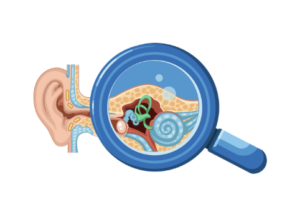 This is the sensation of balance associated with the ear. The actual organ related to balance, the semicircular canals, are located just behind the ear.
The fluid movement in the semicircular tubes provides a 3D signal similar to looking at the bubble in a level. Any changes in position correlate to how far off center we have moved, and in which direction.
Common causes for poor function are medications, head injuries, and illness. If you’ve experience vertigo, you are familiar with this sensory input gone awry.
When you have poor vestibular sensory function, you can be disoriented and fatigued from sensory stress. The brain heavily relies upon your visual system which means working harder to keep you safe.
Low light environments can be particularly stressful.
Proprioceptive Feedback
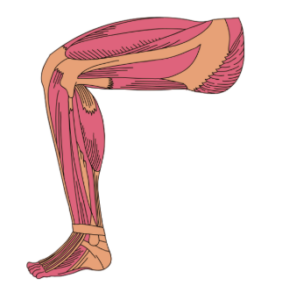 Often referred to as the sixth sense, proprioceptive feedback provides the feeling from our body of where each part of our body is in space. Is our arm reaching up/down/right/left?
The sensory organs are located in joints, tendons, and muscles, so the feet, shoulder, hands, and spine are rich sources of positional information for the brain. (They have lots of interconnections and moving parts!)
Firm or thin soled footwear that allow your feet to ‘feel’ the ground create the most proprioceptive feedback for balance.
Common causes for poor proprioceptive information are injuries, joint replacements, and peripheral neuropathy.
When the body’s feedback is missing or poor, the brain becomes stressed by being more dependent upon the visual and vestibular sensory systems. Again, you can feel tired as well as unsafe.
One observation noted in some of the testing is how the body tries to create missing proprioceptive sensory input by automatically bouncing or swaying, which also makes you less steady.