
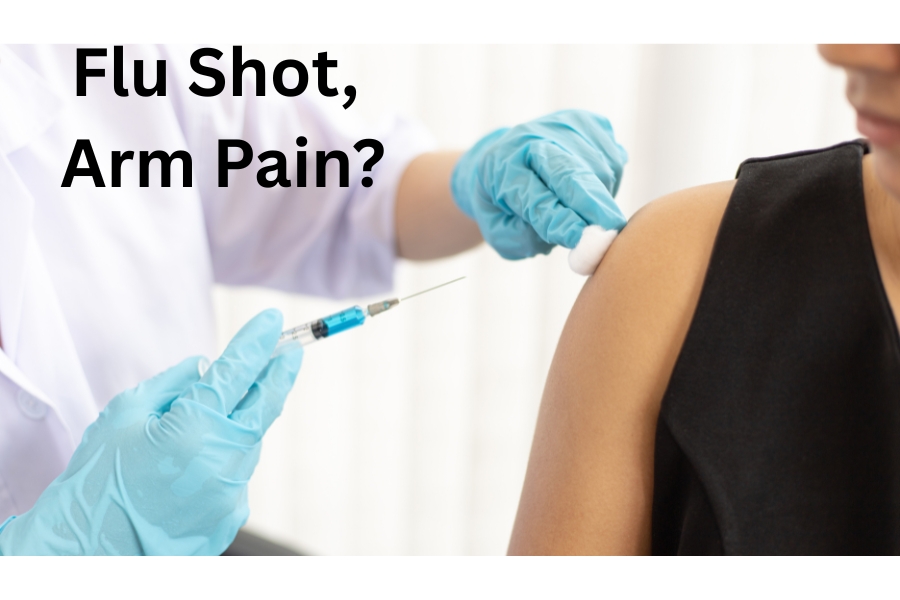
Flu Shot Shoulder Pains?
Jab season has arrived.
Along with the rise in flu cases, the flu shot push has begun. Walgreens seems to have my phone on speed dial begging for me to make an appointment.
No matter which vaccination you get — flu, covid, RSV, or shingles — a sore arm often is the end result. Sometimes your shoulder is stiff and sore too, or has a painful lump at the injection site.
Read on to learn more about why a vaccination may inhibit shoulder or arm movement for a longer time, and a quick tip for how to help.
(This is not about the pros/cons or the appropriateness of a specific vaccine for you. That’s a discussion for you and your medical provider.)
The Jab, the Swelling, the Pain
Not a flu shot story, but the points and experience are similar.
When I had the shingles vaccine last year, it felt like they pushed the content equivalent of a Keurig K-cup into my arm and there it sat. A hard lump which got more painful as the day wore on. The first of the two shots wasn’t like this, so why was this one different?
What happens to the vaccine fluid in your arm?
The syringe push empties the fluid into your deltoid muscle, the muscle located in the top section of your arm. The muscle ideally acts like a diffuser to allow the vaccine ingredients to gradually disperse into the rest of your body. How does this magically disperse?
Your body’s transport system
The circulatory system is the carrier of the vaccine material out to your immune system. That means a vein. The primary vein for the deltoid runs along the front inner edge of the arm, and there are smaller bunches of veins distributed throughout the muscle.
A jab too far away from the veinous structures means that the fluid remains in a puddle inside your muscle, causing discomfort as it slowly disperses.
Think of pumping a pool’s water into the ditch and the water having to find its way to drain on the other side of the drive way. Ideally you would have dumped it closer to the storm drain to clear more quickly.
My shingles shot bump was just this — a little too far over to the side so it didn’t dissipate very easily.
Why is movement inhibited?
This inflammation is what limits your movement ease and range of motion. The fluid build-up also inhibits the way muscle fibers and tendons are able to slide around as they rotate or lengthen when your reach.
With some self-care that I share below, I was able to move easier and the bump began to fade.
How to Help Your Arm Recover Faster
A Hug for Your Arm
This short video shows Becki Logan, Bridging Specialist, demonstrating three simple steps to help your deltoid calm down and recover more quickly.
The step-by-step directions are below.
Step-by-Step Directions
Recovery Gaps After Vaccinations
🟦 Medical Procedures (vaccines)
What you will need:
We recommend a washcloth folded 3 times so it looks like a thick long bandage.
1. HUG Support the entire area AROUND the injection lump, not directly over it. You will be supporting the zone, not squishing it. Patiently and gently hold the support around the area to find the borders.
2. ROCK the area to and fro softly, as if rolling an egg. If you want to count, go back and forth 8-10 times.
3. WIGGLE the area lightly and playfully. You can do this for a count of three.
How often should you repeat this?
Repeat 2-3 times during the day, for a day or two, until the muscle softens and begins to feel normal.
CAUTION: If the area is inflamed, swollen, and warm to the touch, please consult your medical provider. You may be having an allergic reaction needing medical attention.
The goal of the above steps is to allow the adjacent veinous system to better move the vacccine fluid out of the impacted muscle. This allows the muscle to relax and reorganize more quickly, letting your arm and shoulder movement quickly return to normal.