
Balance Testing: One of the Surprises So Far
This week I’m sharing more about the balance testing I’ve been doing of late, including:
- One of the surprise insights (hint: it’s related to a common surgery!)
- How these results translate to tangible actions.
Also, I’ll be doing more of the free balance testing. The sign-up for July 1st times and a waitlist are below.
Keep reading for more …
The Test Insight That Surprised Me
The first week that I began testing balance using the Balance Tracking System (BTS) at-large, it became apparent that there are, indeed, a wide variety of balance skill gaps. Some of the gaps were suspected, and another was a surprise. (Lower numbers are better.)
The device gave credibility and insight to lived experience.
As anticipated, patterns began to surface.
The testing showed a poorer balance score aligned with a past ankle or foot injury. That made sense.
Another pattern emerged that caught me by surprise.
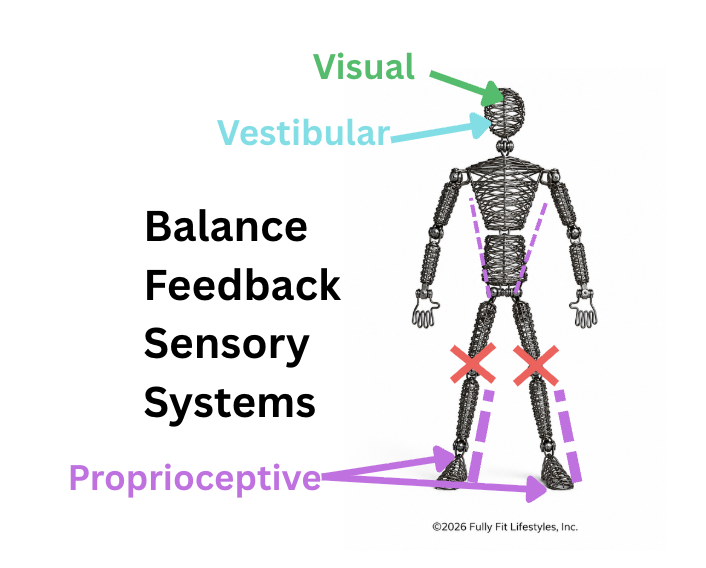
A group of scores were significantly worse when the sensory feedback from the individual’s feet was muted by standing on a soft surface. This simulates loss of sensory feedback from the feet needed to react to changes in the ground surface (smooth, uneven, sloped, etc). This presents a challenge to most people, but the degree of challenge for this group was uncharacteristically high.
The group had one thing in common; they each had both knees replaced.
Given knee replacements are so prevalent these days, it was interesting to see how much worse these scores were, for no other apparent reason. I have a theory (of course!) and will be working to validate it.
Let’s explore more about why knee replacements might affect balance so much.
Gaps in the Traditional Recovery Approach?
After a knee replacement, commonly referred to as TKR or TKA (Total Knee Replacement or Arthroscopy), there are distinct phases of recovery and rehab. Recovery is considered complete when the following measurements are achieved: (source: NIH.gov)
Range of Motion (ROM):
- Knee Extension: Goal is 0° (fully straight) to avoid a limp.
- Knee Flexion: 90° is targeted by 2 weeks post-op, progressing to 100° at 6 weeks, and 115° – 120° by 8–12 weeks
Depending upon insurance coverage and a therapist’s background, they may also assess strength and gait in addition to flexion and extension. However, balance is not regularly assessed as part of TKA recovery. How interesting!
Judging by posts on social media, people struggle to regain full confidence months and years after their replacement. This often includes feeling unsteady.
The people I tested that had had both knees replaced (not recently) all report that their balance could be better. They all exercise regularly doing the sorts of things they should be doing — strength training, Pilates, walking. Yet, given doing all the right stuff, at night they feel less steady!
The balance testing surfaced an insight as to why nighttime might be problematic.
What’s the finding that’s so striking?
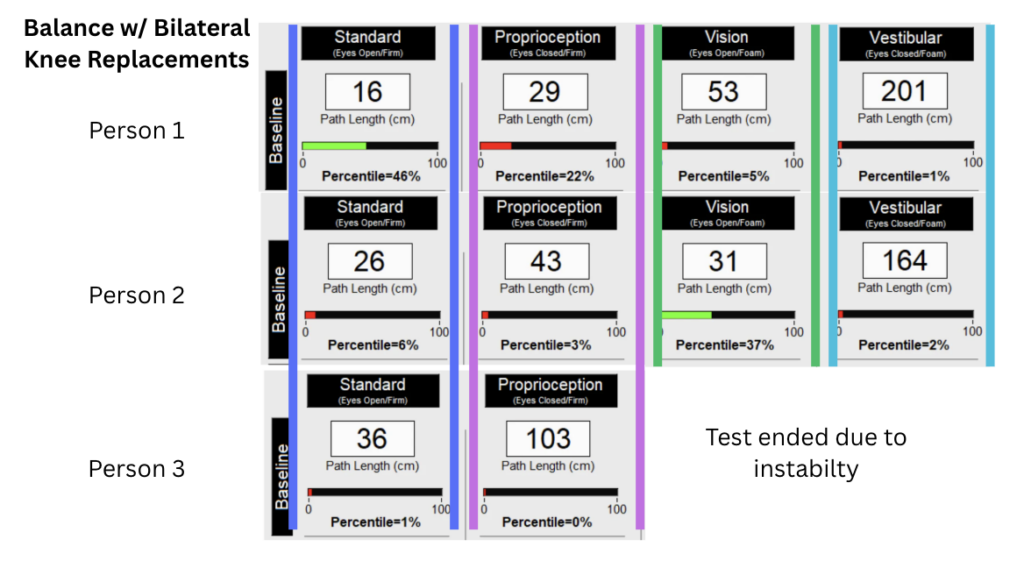
Each person had ok balance standing on the testing device with their eyes open. (Columns labeled Standard and Vision).
But when you introduce very common, everyday variables like a dark environment or unstable ground surface, this group struggled to maintain their balance. This can keep them from being active or lead to more falls!
More insights from the data above:
- Standing on the device with their eyes closed was a little more challenging than eyes open. This portion of the test simulates a darkened environment with little visual sensory feedback. (Data in columns Standard and Proprioception.) Person #3’s balance with eyes closed became very unsteady.
- Standing on the foam pad with their eyes open, balance became more challenging, shown in column Vision. Most people are less steady on a softer surface.
- Standing on the foam pad with their eyes closed was unsettling. Balance wasn’t just a little harder. It was significantly harder, and the scores were off the charts in column Vestibular, and not in a good way.
- Person #3 was so thrown off by the soft pad that we didn’t complete the test with it. (Columns labeled Vision and Vestibular)
Two observations that beg for further study
From this specific TKA group’s results there are a couple of questions that arise, and definately need more data points.
- From the Ortho and Physical Therapy perspective: Measuring balance after knee rehab is not a normal part of the follow-up. What I found in the testing so far makes me wonder if it should be.
- From the patient perspective: Recovery after a knee replacement may leave you with a blind spot when it comes to balance, especially at night or in the dark.
What’s the Possible Connection or Disconnect?
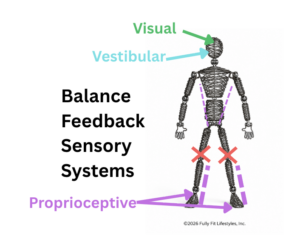 To understand why a knee replacement can impact balance when we reduce both the visual and proprioceptive sensory feedback systems, let’s look at how three aspects of sensorimotor function are at play:
Feet muscles and tendons generate a HUGE amount of information for your brain to act upon!
Those sensory messages travel upward back to the brain to inform the brain what the current conditions are down at the ground. The brain combines this input with that from the ears, eyes and rest of the body to determine if/when a reaction is needed.
IF the artificial knee creates a block in the information flow from the feet upward, sensory messages from the feet can’t get through to the brain.
In dark or dim environments, which limits visual feedback, the brain is challenged with limited situational information to process. Balance reactions can be slowed, inaccurate, and/or unsafe.
A different way to understand this is to consider the dialogue going on in the brain and body.
 Brain: What’s going on down there? Do we need to shift a little forward, back, left, right? If I’m going to keep this body upright and moving I need a clue! Report in please!
Eyes (Visual): Sorry boss, it’s dark and I can’t really help you out.
Ears (Vestibular): Hey boss, I’m doing everything I can do. The head is bobbing around a little and I’m trying my best to help keep us steady.
Core (Proprioception): Hey brain, I’m doing what I can. All my muscles in the core are holding tight waiting if you need us. Not too much info from below for us to act on at the moment.
Hips (Proprioception): Brain, all good here. Rocking and rolling as needed, but not hearing much from my mates, the Feet. Hard to work as a team when they went offline.
Feet (Proprioception): ….crickets…
My Hypothesis: There is a blind spot in balance due to the TKA
Having data about a potential balance threat exposes a gap.
If the altered knee structure throttles the sensory feedback from the feet, a risky balance situation can be made much worse with a soft surface underfoot. The soft surface can be carpet or shoes.
This potential blind spot is something no one is looking for yet explains the unease many people feel long after their TKA recovery. The practical changes below can improve safety which is the end game.
To be fair, this is still a small set of test data. That’s one reason I’m going to continue offering periodic free testing. I want to get a larger sample size to validate (or not) my hypothesis. More testing also allows us to see what other patterns emerge.
What’s the Practical Take-Away from the Test Results?
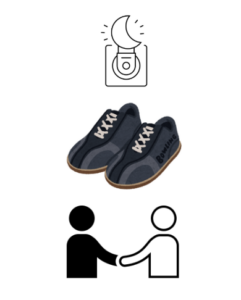 The balance test results beg the question, what should these individuals do? Falling is not on their BINGO card.
The testing done standing with eyes closed on a soft surface mimics the real life scenario of standing in dimly lit or dark surroundings wearing padded sole shoes, or on soft ground.
The recommendations given the poor scores are:
- Improve lighting: At home, place small LED night lights in hallways and bathrooms to improve safety for those overnight bathroom visits.
- Shoes: The soft soles found on popular shoe styles are not for you. No Ooofos, Hokas, or similar. Your feet need to feel a firmer sole to provide maximal proprioceptive sensory feedback to your brain.
- Use Help On Evening Outings: When out at night, hold onto a railing, elbow, or cane to steady you when in poorly lit restaurants and parking lots. It’s better than the alternative, falling!
Of course, I will be fine-tuning the Bridging® muscle resets after a TKA to fundamentally improve this unsteadiness also. In the months to come, I’ll have the ability to retest these individuals and see if there is a change.
Stay tuned!
Interested in Testing Your Balance? More options now available
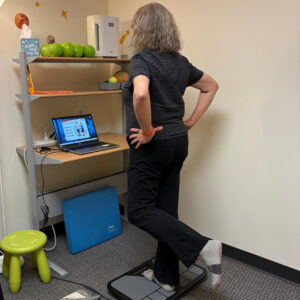 Balance Testing: Can I Test Yours?
Dates: Wednesday July 1 and July 29
Times: From 1 to 3:30p CT
Time Needed: 30 minutes
Location: our Northbrook, IL office
Cost: $0
You will receive a pdf report emailed following the test.
Sign up for your 30 min time at this link.
(You do not need to be a Bridging client to sign up.)
If you’re interested but not able to schedule one of these times, here is a waitlist for a future date.
If you’d like a more personal evaluation and recommendations, the balance testing can be included as part of your session time. Let us know in the appointment note option of your interest to make sure we are set-up for you.