

Broken Bones: More to Recovery Than the Cast
Three friends have fallen in the past six months and broken their wrists. One had surgery and a cast, another had a series of casts, and the other had a cast and splint. Each bone was healed according to common metrics in the orthopedic world.
And yet, they each feel that their wrist function and strength is poor, even after weeks or months of healing and rehab.
Why? Well, there is something to keep in mind when a broken bone is casted … the cast immobilizes the bone AND it also immobilizes muscles and connective tissue.
Tiny micromovements get shut down in the hand and arm muscles, resulting in the loss of function. Merely removing the cast does not restore the many intricate ways the arm and hand move together. These details are what the Bridging® process uniquely considers.
To add some context, I want to share the story of one of the three friends, Judy. Her experience sheds light on why her hand function was poor and painful.
Judy’s Broken Wrist
 My day is brightened by daily photos of the sun rising over Lake Michigan taken by my friend Judy while out on her morning walks. (Photo credit to Judy.)
In early March, she slipped and fell, breaking her wrist. Stops at the ER and Ortho Urgent Care left her with a cast on her arm. In the days and weeks after this, she missed her daily walk as her arm and shoulder hurt too much to be out walking, never mind managing to get a coat on, or hold a phone.
I missed the morning photos! And feel her pain. 🙁
Five long weeks later the cast was removed, and her hand and wrist hurt (not uncommon.) Her elbow hurt. Her shoulder and her neck hurt. The x-rays showed the bones were just fine.
As she began her rehab work with a hand therapist (Occupational Therapist) the pain intensified.
The bone was healed. Why was everything still hurting?
Bridging considers micromovements. When we take this perspective, the gaps in movement flow become apparent.
It is these gaps that cause the pain and tightness. And these gaps can be reset!
Broken Bones, Casts, and the Overlooked Effects on Muscles
Even With Therapy, Why Did Judy’s Arm Still Hurt?
Judy had done all the right things. She had massage, used heat, and faithfully performed her therapy exercises. Yet her hand and arm still hurt. Why?
The answer lies in what happened to all the tissues that were trapped inside the cast, not just the broken bone.
A cast serves an important purpose. By limiting movement and reducing external stress, it creates the conditions needed for a bone to heal. But the bone isn’t the only structure inside the cast. The muscles, tendons, ligaments, blood vessels, lymphatic tissues, fascia, skin, and fat are immobilized too!
Movement Is Essential for Healthy Tissue
Muscles, tendons, and ligaments thrive on movement and are designed to be pushed, pulled, twisted, and loaded throughout the day. When movement stops, these tissues begin to shrink and stiffen. This process is called atrophy.
Research has shown that muscles can lose up to 4% of their volume per day when they are not being used. After a week or two in a cast, that’s a lot of shrinkage. Judy had her cast for five weeks!
The Effects Extend Beyond the Cast
The other body structures inside the cast are part of a network beyond the cast. As the immobilized area shrinks and stiffens, it begins pulling on the adjacent neighborhood of tissue types.
The body responds by shifting and compensating in an attempt to reduce the strain. You can still move, but now you’re often stressing the adjacent muscles, and that is often where the pain comes from!
Gaps in the Traditional Recovery Approach
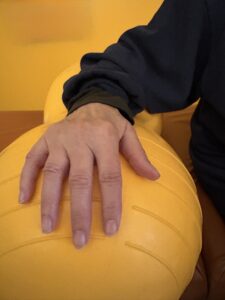 Why Therapy Exercises Need a Precursor Step
After a cast comes off, the typical recommendation is therapy exercises. The goal of the exercises is to rebuild strength, improve coordination, and restore function. Right idea, wrong timing.
Exercise Assumes the System Is Ready
Exercises work best when the correct neuromuscular patterns are already in place. In other words, the muscles need to work in pairs that change partners with different tasks. After a period of immobilization, these movement pairings are often disrupted.
What We Commonly Find After a Cast
Rather than moving in a coordinated sequence, the muscles often move as a single block. Because of this, movement feels stiffer, slower, less precise which adds up to harder to coordinate.
For a visual, imagine a piano. Instead of individual notes played to create a melody, someone slams all the keys at once. This is the way your muscles that had been in the cast are working. They work, but not nicely!
Function First
When foundational movement coordination is disrupted, exercises can restore some of the strength. However, exercise alone doesn’t restore normal function. The dexterity, endurance, and range of motion you may have once had, still seems elusive.
The Missing Recovery Step
Before strength can be fully restored, the body often needs help restoring the coordination between muscles. That’s where Bridging® comes in.
By resetting the pairing of distinct muscle groups shut down by the cast, the body can once again create the fine, articulated movements needed for everyday tasks and hand-based skills.
After this, the exercises are more useful for strength and speed.
 Judy’s Outcome
After just a couple of Bridging sessions, Judy noticed a significant change. Her hand and arm were moving more naturally. The pain had eased. And perhaps most importantly, she was back to doing what she loves—walking by the lake and sending her morning photos once again.
And that’s the goal! A work still in progress, but getting closer to normal.