
ACL Replacement: Solving Nagging Hip Pain and Balance Concerns
 Balance testing is so helpful to narrow down the factors involved in an individual’s challenges, and to provide feedback about recovery progress. This week we look at how balance testing played a role in refining Courtney’s ACL recovery.
- After an ACL tear and rehab, what was still missing?
- How did balance testing play a role in identifying issues to address?
- What did we find from a Bridging® perspective?
- The Recovery Gap: Thoughts for therapists and patients after ACL injuries
Post-ACL Repair and Rehab. Hiking was Fine. Running was Not.
 Courtney tore her ACL (a ligament holding the knee) in a skiing accident a year ago.
She went through surgery and rehab. To test her knee recovery out, she did a 100 mile hike in the French Alps. Her knee did great! (Did I mention that she is an avid outdoor athlete?)
She wants to get back into competitive events again since her knee was doing so well. But when she added running, it was her hip that started protesting.
Living in the western states, much of her training and competing is on trails, not the smooth concrete and paved surfaces I’m used to around the Chicago area. Trail running requires more complex coordination of the feet and legs, as well as balance skills, since the varied surfaces range from soft to rocky.
She was only seeing me once on this visit to the area, so I opted to test her balance to check if the sensory aspects of balance might also be a factor with trail safety and the hip pain.
Balance test insights
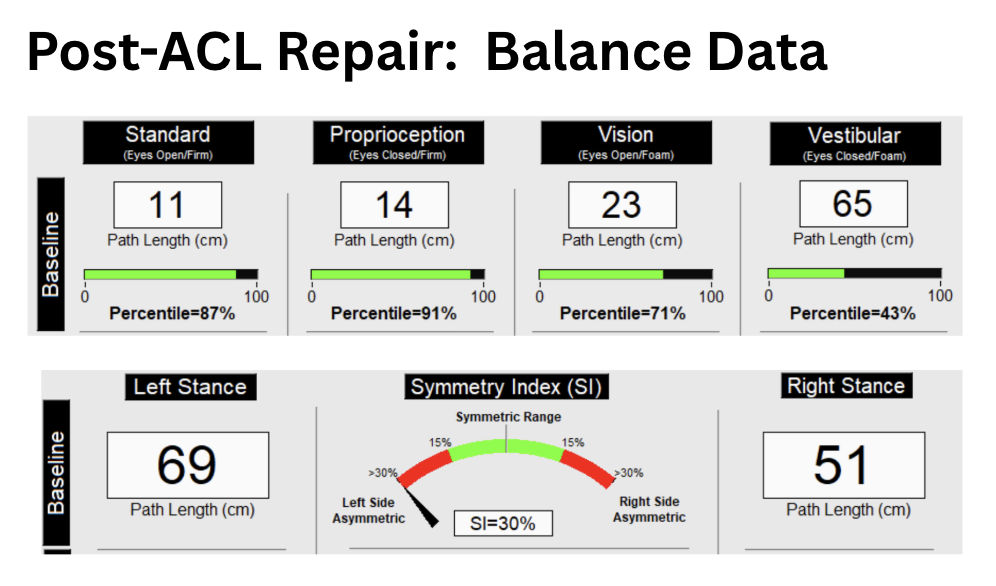
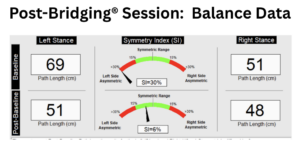
Her general balance was great, as was each of the sensory aspects (first line of data in the graphic below.) I’ve discussed the sensory system balance contributions previously; you can reference that here.
What we did discover was significant asymmetry in single leg balance (second line of data in the graphic below.) between her right and left legs. As you might expect, the torn ACL side was not steady.
The testing highlights a recovery gap in ACL rehab.
Gaps in the Traditional Recovery Approach?
Keep in mind, her knee was fully recovered per conventional standards. She had returned to her intense level of activity, but was having pain elsewhere.
What was impacting her ability to run again?
Traditional ACL rehab ends when the knee bends, extends, and the leg has regained a certain level of strength. For many people, these basics are good enough. For more active people, there is more refined level of function to restore in the leg after a fall or surgery. (We don’t have to be the high-level athlete to benefit from improved function either.)
To help Courtney’s pain and balance, there were three distinct parts of her micromovements contributing to her hip stress and the balance differential.
- Additional Knee Function: Beyond flexing and extending, there are also subtle twisting transitions of the knee muscles, and the ability of the knee muscles to stabilize side-stepping motions. The latter two are aspects of normal day-to-day movement, yet are often overlooked in rehab. Once these were restored, her leg movements were smoother and easier.
- Knee Interconnections to the Ankle and Hip: Flow of movement from the ankle to the hip was interrupted by the above gaps in knee movement. The missing transitions in the knee led to stress at the hip. Once restored, she was able to react faster for better agility, and the hip stress was gone.
- Core Muscle Torque: Injuries often affect more of the body than what is broken or torn. In addition to the ACL tear, she had a twist in her core function related to how she torqued and landed in her ski accident. Once reset, her ease of core movement was centered and further helped restore her sense of balance.
What Changed?
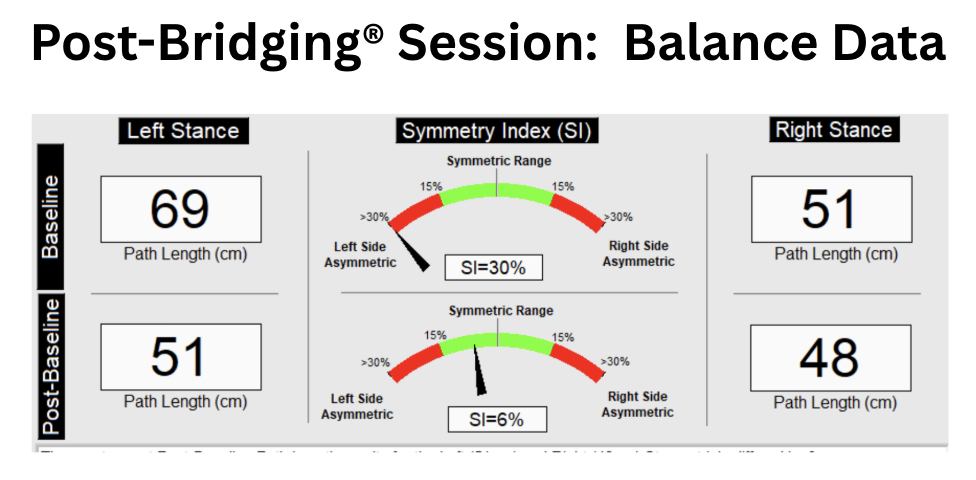
As you can see in the balance scores taken before and after her Bridging session, there was great improvement. (Top score was beginning of session. Bottom score is end of session.)
Symmetric balance was restored by simply doing what the Bridging Technique does best — its process finds the gaps in movement flow and resets the involved muscles to restore movement and coordination.
This was a 24% improvement that took about 30 minutes! (We’ve worked together in the past so we could quickly get through a significant amount of assessing and resetting.)
Courtney was immediately able to sense the calm and ease of movement in her legs and core. The balance testing at the end gave numbers to validate this sensation.
She had done the healing and the exercises.
Bridging found the remaining recovery gaps and closed them.
We’re looking forward to hearing about her next competition!
Gaps in the Traditional Recovery Approach?
Here are some thoughts for you and movement professionals about recovery for ACL and fall-type injuries:
For therapy and movement professionals:
A few questions come to mind:
- Are you checking tri-planar stability at the knee and the entire leg?
- Are you checking it in both closed-chain and open chain function?
- Are you checking balance using test protocols?
All of these aspects of knee function impact overall function and mobility.
And, one more thing … are you checking to see what else was affected by the fall or injury?
It is very common to address only the body part that is screaming loudest. We are kidding ourselves if we believe that was the full extent of the injury.
For people who have had ACL repairs:
You may have both movement and balance blind spots.
If you feel unsteady, have the sensation that your knee is going to buckle or seize up, or have hip stress, these are all signs that micromovement flows are not fully restored.
Consult your professional and ask about these specific details. You don’t need to be an outdoor athlete to benefit!
Video of how leg movement should flow
Often a picture is worth a thousand words. In this short video I show you the various movements we look at with leg function.
On our YouTube channel, there are additional videos of how the Bridging Technique helps improve knees after surgery.
What’s Next: Balance and Youth. Not what you might expect!