
Slip and an Oops! A Young Adult’s Balance Can Also Be Impacted
 Most of us think of poor balance as something only for older folks. This week I’m sharing Ryan’s story to illustrate what we often find when a pain is your main concern: balance is also affected, no matter your age.
Returning from his semester abroad, Ryan had a persistent, annoying heel pain. He was curious, so we tested his balance too, and it was off. After further assessment we realized there was more to both the heel pain, and his balance.
Read on to learn more about how his balance and pain related to each other, including:
- How did our BTS Balance testing uncover a functional gap?
- What did the Bridging® micromovement assessment process reveal?
- What was the outcome for Ryan?
- Thoughts for movement professionals and individuals who have fallen in the past.
A Slip and Slide Leaving Unresolved Heel Pain
After his semester abroad, Ryan’s foot had been bothering him, especially his heel. Walking the streets of Europe had seemed to aggravate it, so he stopped into the Bridging Institute for some help.
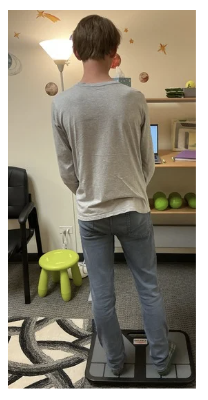
He was also curious about the impacts to his balance so we used the new Balance Tracking System (BTS) to measure it. Some of the numbers were surprising! Maybe something more was going on besides the pain.
Balance test insights
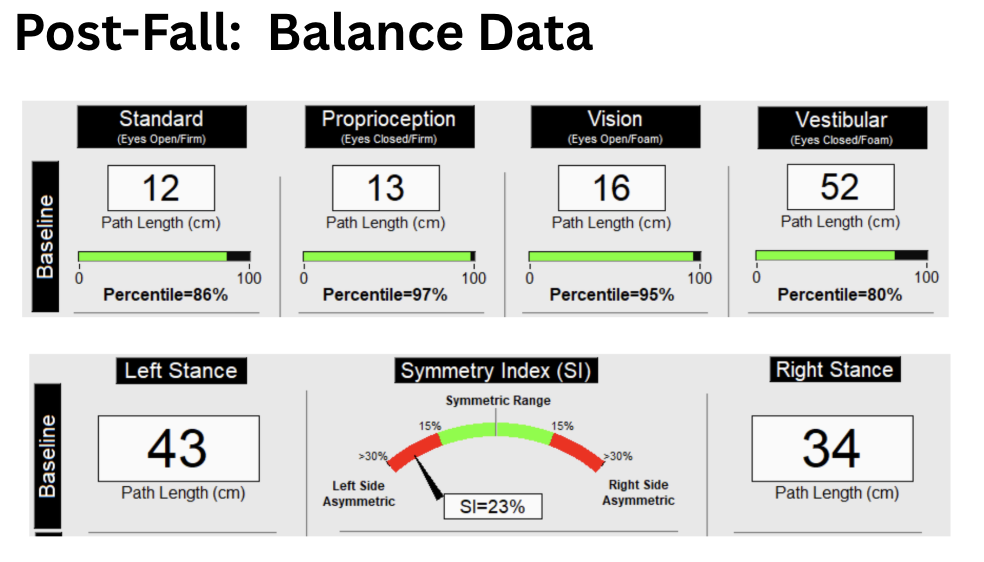
His general balance was great, as were each of the sensory aspects (first line of data in the graphic below.) I’ve discussed the sensory system balance contributions previously; you can reference that here.
What we did discover was significant asymmetry in single leg balance (second line of data in the graphic below.) between his right and left legs. He hadn’t noticed any unsteadiness so this was a surprise.
The testing highlights an unsuspected functional gap.
 Pain and More
Ryan was only aware of the persistent foot/heel pain. It turns out there was more.
What else did the Bridging micromovement assessment reveal?
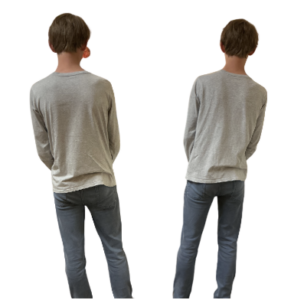
As I went through a basic micromovement assessment, his hip and low back movement stood out–they didn’t move! This, coupled with the BTS data, prompted the recollection of an event he’d forgotten about; misstepping and an awkward slide down to the ground.
The full extent of the slip and slide resulted in impacted function of:
- Additional Ankle Coordination: His heel movement on the side that hurt was indeed jammed. This limited the full interaction with the calf and knee. He walked stiffly which increased impact and added to the heel stress.
- Hip and Low Back Coordination: The hip area where he slid to the ground was not moving. The muscles in this area (glutes) were still traumatized and had stopped coordinating with his core and leg muscles.
- Core Muscle Impact: The opposite side of his core was not moving as it should. Although not directly traumatized, these muscles were rigid due to the inability to coordinate with the glutes and leg muscles.
It was the perfect storm! A shift at the foot and the impact to his glutes managed to shut down so much movement. He didn’t notice since the impacted leg and the rigidity in his core were on opposite sides. In a odd way, his perception of his movement was balanced, even though functionally it was not.
What Changed in the Session?
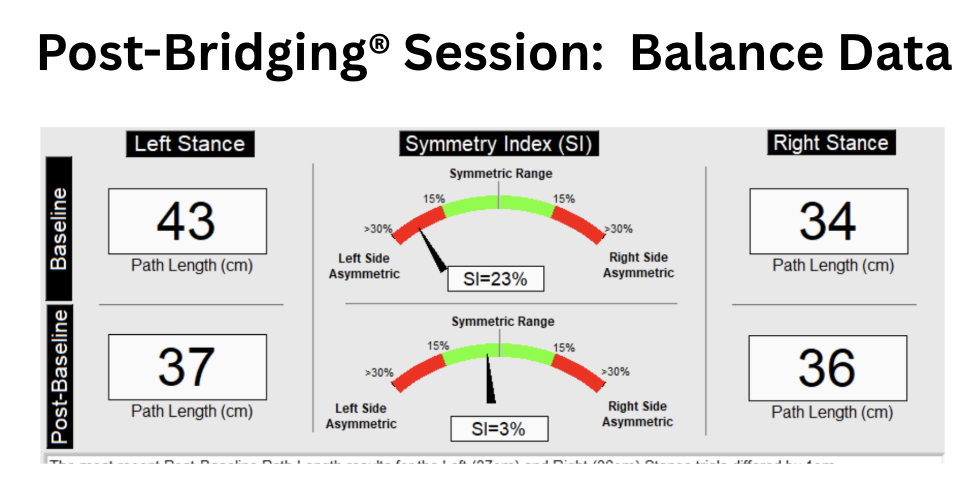
As you can see in the balance scores taken before and after his Bridging session, there was great improvement. (Top score was beginning of session. Bottom score is end of session.)
Symmetric balance was restored by simply doing what the Bridging Technique does best — reset the involved muscles to restore movement and coordination.
This was a 20% improvement that took about 30 minutes! (We’ve worked together in the past so we could quickly get through a significant amount of assessing and resetting.)
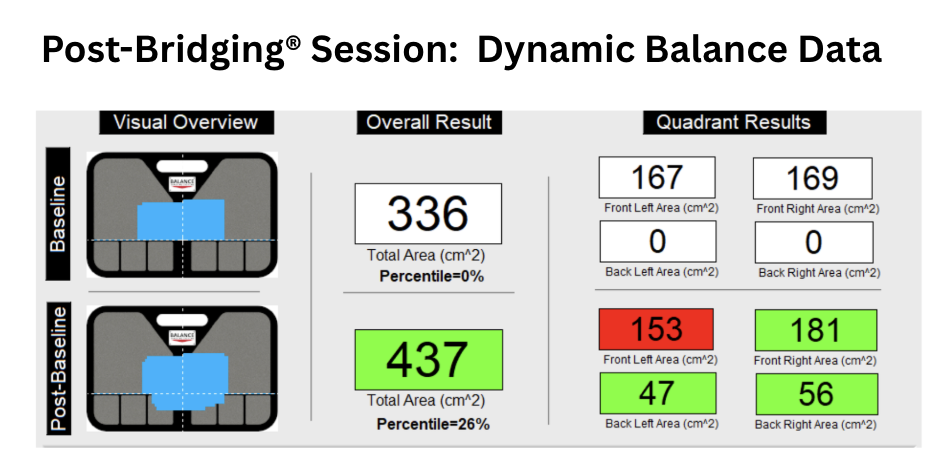
Dynamic Balance: the ability to control your balance as you shift from center.
In this test, Ryan shifted his weight around in four directions (forward/back, left/right). Interestingly, in the pre-test (top line of the above graphic) he wasn’t able to shift his weight backwards at all. This changed significantly in the post-test (bottom line of the above graphic).
This improvement is meaningful for all sorts of life situations, including hiking, carrying awkward objects, and sports, where we find ourselves needing to lean as we move.
Gaps in the “Time Heals” Recovery Approach
This balance and pain saga is common
Many people we see also have these hidden balance gaps, and those gaps can cause compensations that exacerbate their pain.
The main difference between them and Ryan is that he is younger.
Balance can be impacted by an injury at any age.
Poor balance often turns out to be an accumulation of mini-traumas that likely happened years earlier. Without intervention, Ryan’s balance would have been ‘off’ causing uneven wear and tear on his body, and leaving him more exposed to the next oops.
Does this leave you wondering what else remains unbalanced after you’ve fallen?
Thoughts for You and Movement/Therapy Professionals
Here are some thoughts for you and movement professionals about recovery after a slip and fall injury:
If you’ve slipped and fallen
You may have a blind spot with balance which doesn’t go away when the bruise or pain goes away.
Feeling unsteady, having new stiffness, or continued pain without cause are all signs that micromovement flows have been impaired and need a reset.
Your trusted professional should be able to tune in once you provide the above sorts of clues. It they are not yet Bridging trained, they may have other approaches to help, but may take additional time for resolution.
For therapy and movement professionals
A few questions come to mind:
- Are you checking tri-planar stability at the foot, leg, and the entire body?
- Are you checking movement and stability in both closed-chain and open-chain function?
- Are you checking balance using quantitative protocols?
Each of these can impact pain and function. Being aware of the potential presence of these aspects can guide you to a more comprehensive treatment plan.