
Athletic Performance Factor Hidden in Plain Sight
 You train, get new gear, but still aren’t quite able to match the speed or skill of your peers. Or, maybe you seem more prone to injuries.
That’s what Sam struggled with. He plays high level club baseball yet, already at age 15, has had two big knee injuries. He and his parents wondered how his knees could recover more completely and support the high level of performance needed for future play. That led them to the Bridging® Institute.
Read on to learn more about what we discovered was impacting his performance. It’s a factor that can be more common than you’d suspect. This includes:
By taking a different approach, what else can we uncover about functional gaps in an adolescent?
- Why is dynamic balance something to be concerned about?
- Thoughts for you/your child and your movement professionals if you, too, have performance gaps or repetitive injury concerns.
Repetitive Injuries or Performance Limits Frustrating You?
Sam, age 15, (and his parents) were looking for help with his athletic skills and recovery from injuries. His hope is to take his baseball play to the next level.
If you’ve been reading this newsletter for a little while, you’ve learned that to solve movement concerns, I take a big picture look at movement disrupters, which can occur at any point in your life.
In Sam’s case, his earliest experiences held the clues to his present concerns. He was a bit of a medical miracle at birth, coming into this world early (28 weeks!) and being cared for in the NICU (Neonatal Intensive Care Unit) for 13 weeks. You’d never guess that to see him now!
Why was I suspicious of the early life experience affecting his coordination?
As part of the Bridging movement assessment for Sam, I included balance testing using our new Balance Tracking System (BTS). Given his knee injuries and the level of skill required for club baseball, the use of the balance assessment was primarily to rule out background sensory system issues which might be impacting his play.
The balance test scores revealed two qualities as areas of opportunity for Bridging muscle resets to impact. The balance skills most affected were:
- Dynamic Balance: His ability to shift in various directions while maintaining control had quite limited ranges.
- Sensory Related Balance: Visual skills did not help to steady him, and closing his eyes to simulate a dark environment left him unsteady too. (Scores ranged in the 7-19th percentiles)
In general, his balance was good when he was standing still. However, the balance required for high level baseball play is not standing still. The traits supporting dynamic balance had room for improvement!
(A more in depth balance test discussion is below.)
The common observation evident during the testing was lack of movement at his feet and ankles. His swivel base was not swiveling! Why might that be?
Gaps in his early development come into play
Why did his early time in the NICU matter 15 years later?
There are a few reasons, but we are going to focus on one– the zones on his feet and ankles where monitoring bands were fastened.
This is a phenomenon we’ve noticed repeatedly over the years with clients, which is also why the NICU time was a flag for us to check more thoroughly.
Why? The bands create a constraint to his feet and ankles which kept the tiny articulations of the muscles and joint movement from waking up, expanding, and starting to coordinate with each other.
Fun fact about when we are born …
Due to the change in environmental pressure from inside the womb to outside, babies literally expand like a sponge. They go from a high pressure, compressive environment to a lower pressure one. With lower pressure their cells expand in the days following birth.
When a portion of a limb is constrained in the days and weeks following birth, the cells in this restrained area do not expand and begin interacting in the same manner as the rest of the body. The joint or zone impacted retains a stiff quality, even years later!
This rigidity is common when a stay in the NICU is in someone’s past!
That’s what happened to Sam. His lower legs, ankles, and feet felt like they were made of hard plastic; movable, but not pliable.
Why did the rigidity in his feet matter?
For many aspects of balance, the micromovements of the foot and ankle have two roles. When there is rigidity in the feet and ankles these two attributes are compromised:
- Sensory feedback: Generated by tiny stretches and pressure changes in each muscle and tendon, rigidity means no neurological feedback from the feet to understand what is happening at the ground level in real time.
- Ground stabilizing reactions: Shifting in the ankles and mid-foot normally allows easy, natural adaptation to the variations that we encounter as our feet strike the ground. Stiffness results in less speed and slower reactions to changing conditions.
If you’re wondering, yes, Bridging muscle resets can gently and quickly transform feet stiffness to a pliable state in order to better perform.
The details of ‘how’ will be part of another story soon featuring a young man who also had a miraculous beginning.
Thoughts for You and Movement/Therapy Professionals
Often, recognizing the recovery gap is the first step in finding a solution. Early life considerations are often neglected as we age because they were so long ago. But, THEY STILL MATTER!
Recovery Gaps Identified for Sam:
🔴 Injury (knees), 🟢 Early Development (28 week preemie, NICU)
Suggestions for you
If your early life included NICU care, there’s a good chance your muscles are still waiting to be taken out of the ‘shrink wrap’ to move in all the stretchy, twisty ways which muscles connect together.
Once these muscles have their micromovements enabled, your body is able to access the broader network of larger muscles in your body for strength and endurance.
Your trusted professional should be able to tune in once you provide them with the above information. If they are not yet Bridging trained, forward this newsletter explanation. It will give them a new lens to view your concerns through.
Suggestions for therapy and movement professionals
A few questions come to mind:
- Do you ask about early life medical interventions in your intake questions?
- Are you checking movement of individual metatarsals for pronation and supination, including the way they interconnect with the muscles of the tibia and femur for rotation?
- Are you checking movement and stability in both open chain and closed chain orientations?
- Are you checking the ability to connect movement originating at the foot into the knee, hip, and core? The power for pushing aligns with this.
Each of these are necessary for strength and full function. Being aware of the presence or absence of these interactions can guide you to a more comprehensive treatment plan.
Balance Testing Insights
For those who are curious what Sam’s BTS balance testing revealed:
- His single leg balance was quite good! Given both knees had been injured this was indicative of his hard work at recovery.
- The two aspects of balance not supporting Sam’s recovery and sports performance were Dynamic Balance and Sensory-related factors. His results follow below.
Watching him in the testing, it was evident that minimal movement capability of his ankles and feet were a significant factor. We will repeat the testing after several Bridging muscle reset sessions.
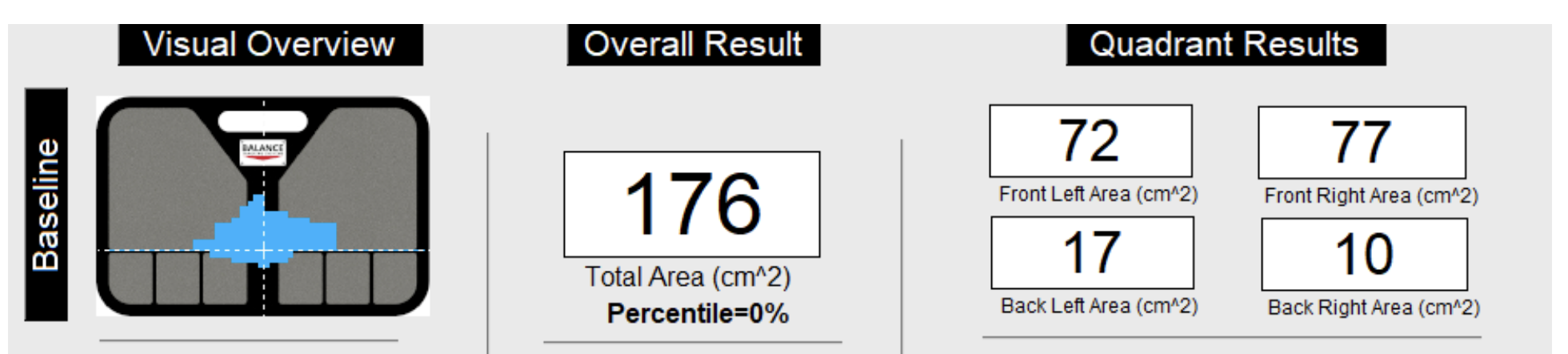
 Dynamic Balance
This test provides insight into how easy it is to shift weight between left/right and front/back while maintaining core control.
A high level athlete will often have huge ranges of control. The results for Sam indicate an area of opportunity. Typical scores for this test are in the 400-500 cm2 range, about 3 times greater than his.
 Sensory Balance Components
While the low numeric scores seem passable (low is good!), when normed with peers, Sam’s low percentiles of performance indicate significant opportunity for improvement.
This test is especially relevant for his baseball play, when plays need to maintain balance on uneven surfaces in various lighting conditions.
For a more detailed explanation of the different sensory aspects, here is a link to a previous discussion.
What’s Next: Dental Work Causing Neck Pain and Stiffness