
Bad Balance? Finding the Specifics of ‘Why’ is a Game-changer!
I often hear …
“My balance is terrible.”
“I’ve been working on my balance and it doesn’t seem to help.”
“I did balance training and flunked. Now what?”
Of course, this type of self-awareness regarding balance is frustrating, anxiety inducing, and, often, limiting in activity choices. And my goal is for you to be able to be active again!
You might imagine the above comments come from an older individual. Sometimes, yes. Sometimes, no.
Teens, young adults, and middle-aged people can also feel a sense of instability. And, yes, it’s just as unsettling!
What to do next? Find the needle in the haystack
That’s where specifics come into play. Instead of doing exercise after exercise to “practice” balance, what if we, instead, find the missing/weak link in the way your muscles work together to keep you steady, and then support that gap?
Yes, this is engineering-based problem-solving at its finest, and why taking a different approach finally leads to a solution for your balance concern.
Read on to learn more about how detailed balance information has provided essential clues to identifying and improving your balance issues.
Balance Basics: What and How
 To better understand why finding a specific gap in muscle coordination can be the pivotal insight to improve your balance, let’s go back to some basics about what balance consists of, how our muscles originally learn to balance, and why these muscle relationships get disrupted.
At its simplest, balance is the ability of the body to appear still. In reality, our muscles are shifting to and fro, very quickly counterbalancing each other as gravity works to pull us down.
There are three directions that our muscles are counter-balancing. Understanding which is not working well is key to helping regain control. The movement directions are:
- front to back
- side to side
- turning right and left
The insight of HOW of a person’s muscles are shifting around to keep them upright holds clues to what may be still affecting your sense of imbalance.
Background: The origins of your balance skills
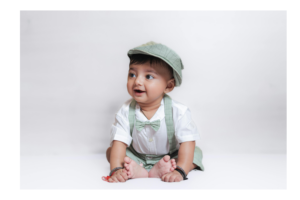 From the time we are rolling and propping up as a baby we are practicing centering each of these movements. Over and over, until it’s mastered. That’s the full-time job of a little one!
The primary balance control we use as adults comes from the core control developed while learning to sit at 6-9 months of age, and from standing/toddling at 12-18 months of age.
If you are able to observe a little one, you will notice their movement begins in a disorganized, falling pattern. Over the days and weeks, their muscle system control and strength evolves such that they seem to be pretty stable.
Children, teens, and young adults can have balance concerns. This can stem from early life hospitalization or injuries in key time periods. Their muscles systems skipped the opportunity to develop the refined postural and sensory integration needed for good balance reactions.
Poor balance in kids often appears as clumsy, hyperactive, or anxious. They do not realize they have poor balance because they have no basis of comparison. The sensation of their body being able to be still is a foreign concept. Isn’t that crazy?! And it changes quickly with specific Bridging® muscle resets.
What causes the micro-coordination balance reactions to go askew?
Injuries involving the head are the most common type to throw off balance reactions. Funny thing is that the poor balance is more about the neck muscles, than the head.
There are so many ways to disrupt the neck muscles which should hold the head in place. A few include:
- Sports and auto impacts and whip-lash. Not always a traumatic brain injury (TBI).
- Dental procedures that keep the head off center for extended periods of time.
- Cataract lens replacements.
- Surgery requiring breathing assistance where the head is turned to the side for an extended period.
When life’s traumas throw off the muscle control between the head and the body, the timing and finesse of the muscles’ ability to auto-correct is compromised. Your balance reactions start to go out of control.
After several months of assessing various balance skills using the Balance Tracking System (BTS), I was recently able to use the information to solve several balance challenges.
The BTS sensors measure and track how much the body shifts around to maintain its balance. A ‘score’ is provided in total centimeters shifted during the 20 seconds of the test. This numbers is the statistic.
The sensors also provide a directional trace of this movement. The pattern tells the story about how the body is reacting in order to stay balanced.
Balance Test Movement Traces
The Picture Tells A Story!
What is going on?! The traces shown below of the balance testing for three different individuals show a clear difference in the last of each series! Two times standing with eyes open, and the last was standing with eyes closed.
The muscles changed their reaction strategy for balancing when visual feedback was taken away. Or, perhaps, their visual feedback was the compensation for a missing vector of balancing reaction stability. Specific insight to test for specific solutions.
BTW- They had each done vestibular or balance training previously and not made as much progress as hoped for.
The movement trace is the ‘gold’
 The directionality of how their neuromuscular system was adapting revealed a story of their balance issues.
Person 1 – With a past head injury. A distinct pattern of balance instability surfaced when eyes were closed. The unstable sideways movement happened to matched the details of a past head injury. Bridging support to the head and neck allowed the muscles supporting the head to reset and recenter. This allowed the balancing reactions and the body to work together again, as they had originally learned years ago.
Person 2 – With an assortment of medical procedures in the hips, core, shoulders, spine. The test trace showed a normal muscle strategy of 3D shifting with eyes opened. When eyes closed the forward-back direction became exaggerated. However, this person’s ability to control forward-back movement was poor. Support for this one was more complex–all the areas of prior procedures mattered. The forward-back control changed with a series of Bridging resets, and balance reactions improved.
Person 3 – With a medical procedure: More nuanced, this person’s head had been immobilized to one side during a lengthy procedure. The muscles were stuck in this position affecting balance afterward. Their balance reactions were shifting wildly in all directions trying to maintain stability. The Bridging muscle resets to their head, neck, and shoulders allowed their head to more naturally center, which re-centered their balance reactions.
Thoughts for Your Movement/Therapy Professionals
Recovery Gaps Impacting Balance
🟦 Medical Procedures (Surgery with intubation, involved dental work, shoulder/neck surgery, cataract lens replacement)
🟥 Injuries (head/neck/shoulder injuries including whiplash, auto and cycling accidents, falls)
Suggestions for therapy and movement professionals
If your client/patient has had a tough time with balance, here are some steps to consider:
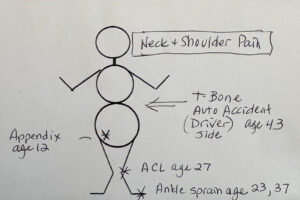 1. Assess! What are the strategies a person’s neuromuscular system is currently using to stabilize their balance? Identify and understand which movement place is working well, and which is working poorly. Ideally, use a balance test device to measure specifics of the balance reactions.
2. Map out injuries and medical procedure traumas. Which of these are impacting the body’s ability to shift in the planes of movement which are unstable?
3. Test out support to the injury impact or medical procedure area. If the area is related to the balance impairment, a support will enable better control when reassessing. This support can range from K-Tape to a brace, or your hand.
4. Focus on finding a more permanent support/change to the area yielding the best improvement.
Taking each of the above into account allows the impacted muscles to relax and reorganize more quickly, and can guide you to a more complete improvement in balance.
If you’re interested in learning the Bridging muscle resets to better help your patients after injuries, there is a new cohort kicking off in February 2027 and you can join the waitlist here.