
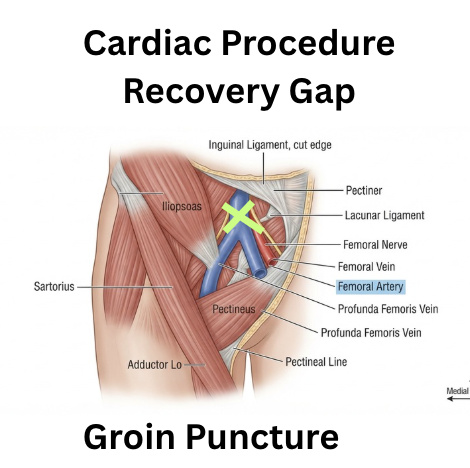
Hip or Back Pain, or Balance Concerns?😩 A Surprising Cause!😲
Sharing about a trend I’ve been noticing with new clients having hip or low back pain …
My clients were discharged by their electrophysiologist after successfully stabilizing their heart rhythm. BUT … as they began to increase their activity, pain surfaced. Hip pain or tightness, lower back pain, pain with sitting, and pain with walking. Relief was elusive and fleeting.
Many of you do not have cardiac issues, but if you have friends and family over the age of 50, chances are someone has had a stent or an ablation (A-fib), or will in the future, to fix their heart function. Sadly, many will have hip or low back pain afterward, and not realize there is a connection — there is!
Because these procedures are done over 1M times per year in the US, with a rate of increase of 10% per year, I wanted you to know these recovery-related issues CAN CHANGE — often rather quickly.
There IS more recovery possible!
Please share with others who have had a cardiac procedure with an insertion through the groin. There is help to allow them to be more active, and feel good doing it again!
Beyond the Ablation Recovery
Stent Placement and Cardiac A-fib interventions have become more common as surgical procedures and device advances have become less invasive and more effective. However, if the procedure fixed the heart issue, why are these people still having an issue with being active?
The hip is the key. My clients arrived frustrated by hip or low back pain. They had stretching routines, but these had stopped helping. They were at their wits’ end trying to figure out what else to do for relief.
They understood the importance of being active for their overall well-being, but felt caught between a rock and a hard place. The more they tried to stay active, the more their lower body hurt. They also happened to have cardiac procedures in their past.
Why? The procedure punctured the groin, which can lead to a host of issues in recovery. In addition to healing complications, there is often pain or stiffness. These can impact ease of movement as well as steadiness for balance reactions.
The root cause? The procedure itself can leave long-lasting trauma to the muscles in a critical area of the body. The muscles in the groin area were disturbed and need specific support to reset to work together again.
What’s the issue from the muscle perspective?
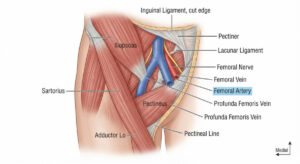 The groin (inguinal fold) is a critical structural junction!
The area where the stent or ablation device is inserted (red and blue tubing in the center of the image) contains many important structures tightly packed in a small space. They all are disturbed with a procedure in the area! The structures include:
- The femoral vein and artery, the primary blood vessels for the leg. The vein is commonly used for the ablation. The artery is often used with stent placements.
- The femoral nerve, the primary nerve for the leg. It can be aggravated with the general disruption to the area.
- Lymphatic vessels which carry lymphatic fluid to/from your leg. The swelling associated with healing of the area may limit lymphatic flow through this small channel and result in atypical swelling in the lower leg.
- Muscles! The illiopsoas (hip flexor, and in/out mover), the sartorious and adductor longus (both part of the quadriceps muscle group), and the pectineous muscle (a connector to the pelvic floor). These muscles, or their tendons, cross the zone of the procedure.
The muscles can be disturbed by the procedure directly, or they are impacted by the body’s protectiveness and swelling during the healing process of the vein or artery wall.
Muscle teamwork in dissarray
In reality, all the muscles in this area need to work as a team. Some turn and stretch while others tense to stabilize a movement. The aggravation caused by the procedure throws this finely coordinated teamwork into disarray.
What remains is:
- Restricted and/or uncomfortable hip movement causing hip pain and tightness.
- Hip tightness which can pull at the lower back causing unexplained back pain.
- Poor muscle coordination, which can impact of your balance reactions.
What can you do about this? That’s next.
Thoughts for your massage or physical therapist
Recovery Gaps Identified from Cardiac Procedures at the Groin
🟦 Medical Procedures
If your client/patient has had a tough time with balance, mobility, or strength following a cardiac ablation, please consider the supports that follow.
Taking these two steps allows the impacted muscles to relax and reorganize more quickly, and can guide your patient to a more complete restoration of movement flow, ease, and strength.
If you’re interested in learning the Bridging® muscle resets to better help your patients after injuries or surgeries, there is a new cohort kicking off February 6, 2027. Add your name to this list and you’ll be notified first when registration opens.
1. Support the surgical scar area to stabilize the affected muscles using a washcloth folded in 1/8ths. Use the other hand to gently rock the leg at the area adjacent to the surgical disruption. Once the muscles calm down and are ready to work again, the movement in the area becomes smooth and engaged.This short video shows you what to do.
NOTE: This step is appropriate with medical clearance for light movement. Often this is 4-8 weeks post-procedure, depending upon the specific intervention.
2. Guide the movement to link integrating the scar zone. Stabilize the scar area with the folded washcloth. There are three movements to guide the leg through while supporting the groin scar.This short video shows you how simple this step really is, taking the leg through adduction/abduction, rotation, flexion and extension of the hip.
NOTE: This step is appropriate with medical clearance for exercise. Often this is 10-12 weeks post-procedure. Please wait at least 10 weeks to allow for sufficient healing of the blood vessel walls.
DO NOT FORCE any of the range of motion.