
Early Life Respiratory Illness: The Effects No One Talks About 😷
Quick Overview: This is part 2 of 4 discussing respiratory illness
Included today are:
- Why early respiratory illness affects posture, strength, and behavior—and what can still change.
- The long-term movement impacts from childhood illnesses are real—even years later.
- Understanding the invisible impacts to upper body development from an early respiratory event.
Early-Life Respiratory Bugs Are Bad in So Many Ways
If you — or your kids — had a significant respiratory illness at any point in your early life, that experience may still be influencing how you (or your kids) move, breathe, coordinate, and even self-regulate today.
I write about and help people with movement, so how the heck do respiratory illnesses connect to strength, coordination, development, and self-regulation?
Here’s the short answer:
A child’s breathing system is under constant structural stress just to keep up with growing. When illness disrupts breathing early on, the body will find a way to keep breathing — because it has to — but often at the expense of subsequent development. The earlier the illness, the more developmental nuances are affected.
Those compensations don’t always disappear once the illness resolves because they caused a fundamental shift in the developmental trajectory. The physical and structural impacts may not be obvious, but I guarantee they’re there. Even years later. And yes, they can change.
Today, I want to ground this discussion with a real example — my own. Let’s dig in!
Let’s start with a story …
Cara and Pneumonia: Impacts to Strength, Stamina, and More
 I’ve shared before that I had pneumonia four times before age five, including at least two hospital stays in an oxygen-tented crib.
My lungs and diaphragm were a mess. I became a chronic mouth breather, relying heavily on belly breathing. My ribcage stayed rounded, my posture followed, and bronchitis and colds were constant companions.
As a kid, I was active — but selectively so:
- Swimming and biking? Yes
- Running? Hard no
- Upper-body strength activities? Absolutely not
Crab walking, pull-ups, monkey bars, running — these were mysteriously harder for me than for other kids. I was also quiet, shy, and soft-spoken. A withdrawn posture and timidity often travel together.
For so many years, none of this made sense to me, both as a child and as an adult.
Years later, through studying muscle coordination, micromovements, and how body systems develop, it finally did. Keep reading for a more detailed explanation on what I discovered and how it has changed my life.
My Good News
My breathing, endurance, posture, and confidence are dramatically better today. Upper-body strength is still a work in progress — but Bridging® sessions over the years have made a tremendous difference, even decades later.
And yes, I run now. Regularly.
Why Do Early Respiratory Illnesses Affect Development?
In reality, the same elements of a respiratory illness impact infants and children as well as adults — reductions in diaphragm and rib movement which affects shoulder and hip function.
The BIG DIFFERENCE is that infants and children are still developing!
Their evolving posture, coordination, and strength relationships are affected, and not always in obvious ways. Often the outward clue is behavioral — meltdowns, defiance, or moodiness.
In the following two sections, I outline the seven top ways early development can be derailed by a respiratory illness. These lead to the top five clues for how the aftermath of a respiratory illness is still impacting your child.
Seven Developmental Glitches From An Early Respiratory Illness
These illnesses are such a big deal!
Why? Because of the many primary aspects of development that are impacted by a restricted chest and limited core movement.
These are very often associated with a respiratory illness such as RSV, bronchiolitis, flu, COVID, pneumonia, bronchitis, and some types of asthma.
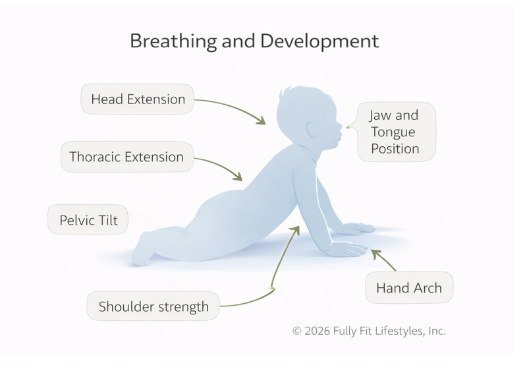
- Lack of core extension which forms the spinal curves for posture
- Incomplete head extension which allows the eyes to focus forward when moving
- Lack of deep diaphragmatic breathing needed for endurance and fueling growth
- Incomplete pelvic tilt development and bladder control development
- Incomplete shoulder strength integration impacting push-up and pull-up strength
- Incomplete hand arch development needed for grasp strength and fine motor skills
- Incomplete jaw position maturation which happens when the head fully extends
For children, these strength and postural relationships develop while lifting up and pushing up from the ground in tummy time. Even though the skills may have developed in infancy, a childhood respiratory illness can restrict and regress the relationships.
As an adult, you may have persistent issues with one or more of the impacts listed above, and be frustrated by the inability to improve it. Solving for the correct root cause is key to effecting change.
When the chest and diaphragm are unable to elongate due to constrictions from the illness, there are ramifications throughout the body!
Top 5 Kids Day-to-Day Behavioral Clues
 Different from adults, kids can’t often articulate that they feel ‘off’.
The effects from a respiratory illness are often not the actual physical traits. It’s the behavioral clues that are your signal that the breathing-muscles are not working well with your child.
From Becki Logan, our resident Bridging® Specialist, these are the most common behavioral correlations she hears from parents:
Easily fatigued: “I’m tired” after half a block. “Daddy, carry me.” Familiar?
Unexplained chest pain. Often labeled as asthma once serious issues are ruled out—but structure still matters.
Poor coordination (especially arms, hands). Shoulders lack stable support from the ribcage, affecting reaching, swimming, and fine motor control.
Weak voice or speech projection. Voice comes from diaphragm pressure. If breathing is compromised, voice support suffers.
Inability to access a calming breath. Belly breathing or mindfulness exercises don’t help if breathing mechanics aren’t coordinated. Kids may resist because it genuinely doesn’t work for them.