
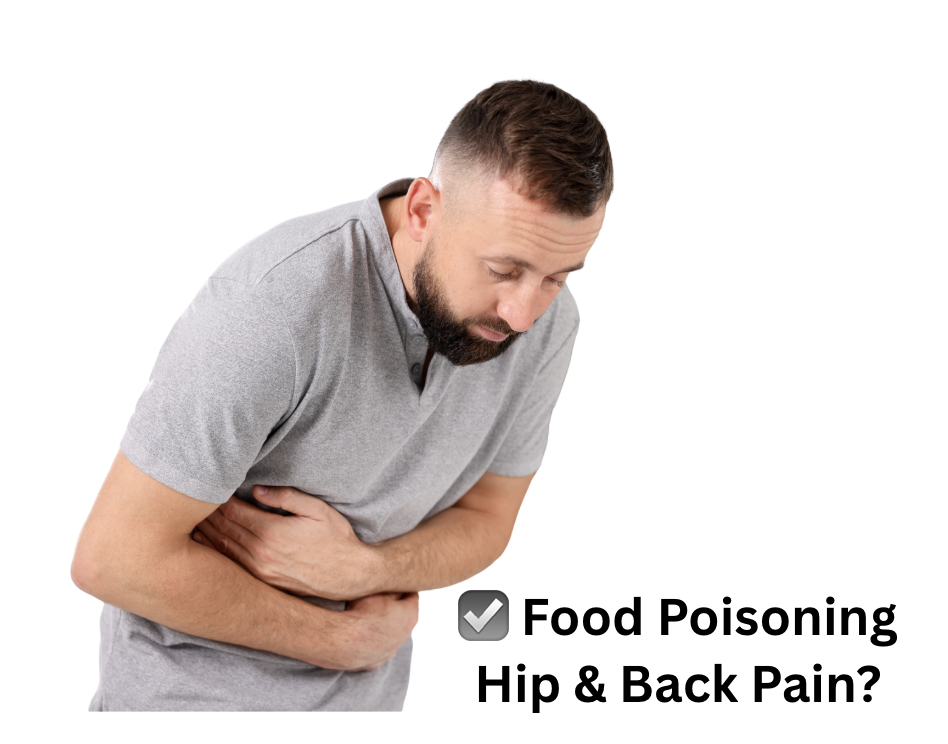
Tummy Troubles Leave You With Hip/Low Back Pains?
“I had a terrible case of food poisoning, like the kind when you sweat bullets wondering if you’ll make it home, and start thinking through contingency options. It lasted two days!”
My client had scheduled the session with us to work through additional movement and balance function related to her knee replacement last year ago. Instead, her hip and low back were bothering her and that became the priority for the day.
What had changed in the month since we’d last spoke that might relate to the new issues? The FOOD POISONING!
Grab your Immodium while we look at why a bad stomach bug and hip or back pains can go together.
Given the recent lettuce-related food issues and the seasonal norovirus, you may know someone else who has also been impacted. Please share this post!
 The Other Function of Core Muscles — Pressure Regulation
Aesthetics and strength are common goals people want for their abdominal muscles. Most of us aspire to have strong abs because a strong core is good for many reasons — how we stand, how we move, and how we look.
However, an important, yet under-appreciated role of the abdominal muscles is to provide a stable wall capable of regulating the internal pressure in the abdominal cavity, which supports both breathing and digestion. Yep — it’s pretty important!
Why is this pressure regulation affected?
I consulted Claude (an AI resource) for a simplified explanation of what happens when we get a bad tummy bug. One key point from Claude’s description follows. (I included the entire response to my query at the end, if you’re interested in reading more details.)
Claude says
Food borne illness disrupts the regulation of intra-abdominal pressure (IAP) primarily by causing physical and physiological changes within the abdominal cavity that overwhelm the body’s normal control mechanisms. The delicate balance maintained by the diaphragm and abdominal muscles is also affected.
Altered Muscular Reflexes (Abdominal Guarding)
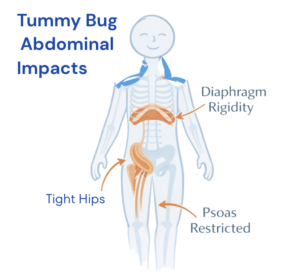
Inflammation and the resulting visceral pain can trigger viscerosomatic reflexes. In response to pain, the body often initiates “abdominal guarding” — an involuntary, sustained tightening of the abdominal wall muscles to protect the inflamed organs.
- Under normal circumstances, the abdominal muscles and diaphragm work in a coordinated, flexible rhythm.
- When guarding occurs, the abdominal muscles remain chronically tensed, which prevents the diaphragm from moving freely and disrupts the synchronized “give-and-take” between the top (diaphragm) and sides (abdominal walls) of the abdomen. This rigidity impairs the body’s ability to appropriately modulate IAP in response to movement or breathing.
Why Does This Relate to Back or Hip Pain Two Weeks Later?
Good question! The rigidity of the abdominal wall and restricted movement of the diaphragm cause some key compensations which are the root of the pains. Some typical compensations are:
- Forward Posture: The tight muscles in the lower core pull your upper body forward. Your body loses the elasticity to extend backwards.
- Tightened Psoas/Hip Flexor Muscle: The illiopsoas muscle connects the lumbar (lower) spine to the inner edge of the thigh. Its job includes bringing your knee up, as well as stabilizing your leg when moving side-to-side, and when turning outward.
- Tightened QL muscles: The quadratus lumborum (QL) muscle is another connector of the lower core to the legs. It helps stabilize how the low back and legs work together.
From just these three interactions you start to get a sense of why food poisoning or a tummy virus can leave you with other aches and pains weeks afterward.
The tightened muscles may relax a little over time, but getting the critical relationships of the abdominal muscles to shift back to normal is hard for your body to do on its own.
The physics of pressures is really cool–pressure relationships are very stable and self-correcting. This makes for a robust system within the body. UNTIL something happens. Next up, I’ll explain how we can use a pressure support to help the body find its way back to normal.
How to Reset: Step-by-Step Directions
Recovery Gaps After Tummy Troubles
🟨 Illness (food poisoning)
 The general goal:
The goal is to help the body to reset the pressure regulation in the core. You will do this by providing support around the soft area of the abdomen. With soft external support, the pressure can stay supported while the muscles relax and regroup.
The rigidity in the abdominal muscles will begin to relax. Breathing becomes deeper and more regulated, and the muscles between the low back and legs can relax too. Your pain and stiffness melt away. The pressure relationships are reset and can maintain themselves until something else happens.
What you will need:
- We recommend a decorative pillow about the width of your belly, a pillow, or a folded bath towel.
- A partner/friend with long arms or a big reach.
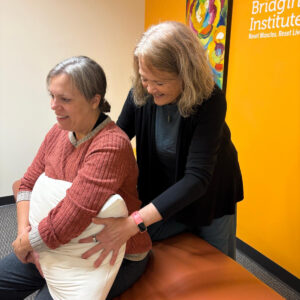
1. HUG Sit and place the pillow or towel just under the ribcage on the front of the belly. Support the entire area AROUND the abdomen. Have your partner/friend reach from behind. The pillow and partner are lightly supporting the zone, not squishing it. Patiently and gently hold the support around the area.
2. ROCK After 10 seconds, begin to lightly rock the pillow to and fro softly, as if rocking a little one to sleep. If you want to count, go back and forth 8-10 times.
3. HOLD The pause will allow the muscles a chance to relax and regroup. You can hold for a count of three.
How often should you repeat this?
Repeat 2-3 times. You can also repeat during the day, for a day or two, until the muscle softens and and breathing begins to feel normal. Your deeper breathing is the key to sustained function.
CAUTION: If the area is painful to the touch, please consult your medical provider. You may be in need of additional medical attention.
You may realize this looks a lot like doing the Heimlich Maneuver. Yes, that true. There is a key difference — the pressure is distributed around the abdomen, not centered in the front. The movement is gentle and held, not abrupt and forceful.
What’s Next: More Balance Testing and 2027 Level 1 Course Dates
The Full Response from Claude (AI) about how foodborne pathogens disrupt intra-abdominal pressure (IAP) support.Foodborne illness disrupts the regulation of intra-abdominal pressure (IAP) primarily by causing physical and physiological changes within the abdominal cavity that overwhelm the body’s normal control mechanisms. The delicate balance maintained by the diaphragm and abdominal muscles is interrupted through three main mechanisms:
1. Increased Abdominal Volume (Distension and Gas)
Foodborne pathogens and the resulting inflammation often cause rapid fermentation of intestinal contents by bacteria, leading to the production of excess gas. This increases the total volume of contents within the gastrointestinal tract, causing abdominal distension.
- Because the abdominal cavity has finite space, a physical increase in volume forces the abdominal wall outward and directly raises the baseline pressure within the abdomen.
- This shifts the resting tension of the abdominal muscles, making it harder for them to maintain their usual, nuanced regulation of pressure.
2. Forceful Muscular Contractions (Vomiting and Retching)
Vomiting is a protective reflex that relies on creating high intra-abdominal pressure to expel stomach contents. When triggered by a foodborne illness, the body engages in a violent, coordinated effort:
- The abdominal muscles contract vigorously to squeeze the stomach.
- Simultaneously, the diaphragm may contract in a way that shifts the pressure dynamics to assist in expulsion. These contractions create rapid, high-intensity spikes in IAP that far exceed the normal range needed for trunk stabilization or breathing. These extreme fluctuations temporarily override and disrupt the normal, steady regulation of pressure.
3. Altered Muscular Reflexes (Abdominal Guarding)
Inflammation and the resulting visceral pain can trigger viscerosomatic reflexes. In response to pain, the body often initiates “abdominal guarding”—an involuntary, sustained tightening of the abdominal wall muscles to protect the inflamed organs.
- Under normal circumstances, the abdominal muscles and diaphragm work in a coordinated, flexible rhythm.
- When guarding occurs, the abdominal muscles remain chronically tensed, which prevents the diaphragm from moving freely and disrupts the synchronized “give-and-take” between the top (diaphragm) and sides (abdominal walls) of the abdomen. This rigidity impairs the body’s ability to appropriately modulate IAP in response to movement or breathing.