
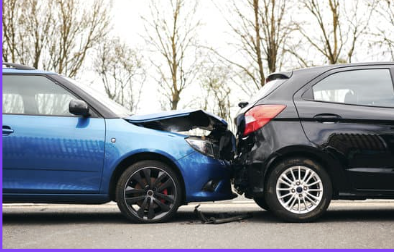
Rear-ended or T-boned, and You Were Fine?
Rear-ended, but “I feel fine.”
Vehicle Accidents: Why Your Lingering Pain May Be Connected
As we move out of winter, everything seems to speed up — including drivers. With that speed (and plenty of distraction) comes accidents.
If it happens, you may walk away thinking, “Thank my lucky stars.” Or, maybe you feel shaken, but otherwise still feel ‘fine.’
Here’s a tip, you may not really BE fine.
In this short series, we’ll look at how vehicle accidents can quietly affect your body — and why pain can show up months or even years later.
What We’ll Cover
- Part 1: Rear-end and side-impact (T-bone) accidents — and the lingering effects you may still feel
- Part 2: How the Bridging® technique assesses these impacts through micromovement — and how specific resets restore movement
Why Do I Still Have Pain?
Pains Linked to Prior Vehicle Accidents
In our office, a surprisingly common root of our clients’ ongoing pain or mobility issues has to do with a past vehicle accident – usually rear-end or side-impact collisions.
Using our unique micromovement assessment, we consistently find unresolved compression and torque patterns in the body. These patterns often explain the persistent pain, tightness, or imbalance — even when the accident happened years ago.
To understand why this happens, we need to look at something most people never think about: Seatbelts.
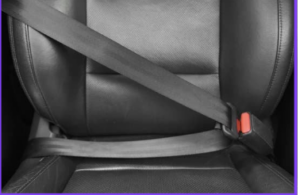 The Hidden Injury Mechanism Stemming From Seatbelt Impact Points
A seat belt’s three-point harness works well for keeping you from flying through the windshield in an accident.
From a physics perspective, tho, it can create odd pain patterns because one side of your upper body is restrained while the other is not.
That imbalance creates very specific force patterns in the body:
- Rear-end collision: One shoulder is driven forward while the other is held back.
- Side-impact collision: Your entire torso is thrown sideways until the center console stops it (often abruptly).
When compression and torque enter the picture, that’s where your body’s problems begin!
A Quick Note on Seatbelt Design
Seatbelts were first required in U.S. vehicles in 1968, with state-by-state adoption following in the 1980s and beyond.
Today’s standard three-point harness was a compromise — balancing safety with public willingness to actually wear it. More secure systems (like four-point harnesses) are used in racing and infant carriers, but never became mainstream for everyday drivers.
Three-point seatbelts are optimized for front-impact crashes. They are far less effective at distributing force during rear-end or side-impact collisions.
Five Common Pain Patterns After Rear and Side Vehicle Accidents
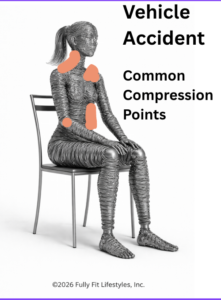 If you are still having pain after an accident, you aren’t having random symptoms. The issues from vehicle accidents follow predictable structural patterns within the body. These are the most common that we observe:
1. Shoulder Pain
In a rear-end collision, the impact force is rebounded from the seatbelt into the shoulder (left shoulder for drivers, right shoulder for passengers.) This creates fast, localized compression that the underlying muscle tissue often doesn’t fully rebound from.
2. Elbow Pain
If your hands are on the steering wheel, the force of being hit from behind transfers through your arms. The elbow becomes the primary shock absorber — a role it was never designed for — creating compression and torque at the joint.
3. Neck Pain
When shoulder movement is restricted (see #1), the neck is often affected too. The shoulder tightness causes tension of the head muscles which results in your head pulled slightly off center. Often the related complaint is persistent neck stiffness or tension.
4. Brain Fog
When your head is off-center (#3), your visual and vestibular systems (eyes and inner ear) no longer align properly. Your brain has to work harder to interpret incoming sensory signals — resulting in fatigue, slower processing speeds, aka brain fog.
5. Lateral Core Stiffness (and “Crooked” Posture)
More common in side-impact collisions, where one side of the torso muscles is compressed and the other is overstretched. The result is imbalance in how the right and left side core muscles coordinate, often yielding a postural skew to the side and making a side bend difficult.
Why The Above Don’t Resolve on Their Own
If you’ve been rear-ended or T-boned and your body still doesn’t feel right, there’s likely a reason. These are not just strength or flexibility issues. They are mechanical disruptions in how force moves through your body.
What Can You Do?
Bridging® addresses these patterns directly. By decompressing and re-coordinating the affected areas, the muscles can begin working together again — often quickly.
In Part 2, we’ll break down why these effects happen from a physics perspective — and how targeted resets can quickly help.