

Minimally Invasive, with Major Muscle Impacts!
Each day at the Bridging Institute we see a variety of people with pain and movement concerns.
It’s uncanny how many of them have a minimally invasive procedure in their past. Although the scar is minimal, the surgery is deceptive in terms of how the core muscle coordination can be disrupted.
In this series, we’ll explore why one of the most common types of surgical procedures can create long-lasting stress in the body — often showing up as pain months or even years later.
What we’ll cover in the series:
- Week 1: The procedure—and why it disrupts movement (Link here)
- Week 2: Bridging® support at different points in the recovery process
- Week 3: Why the support for children vs. adults differs
- Week 4: What you can do to help yourself
After Minimally Invasive Surgery … Specific Support Reorganizes Your Body
The clients we meet are generally frustrated with pain. When they tell us they have had a minimally invasive procedure in the past, we immediately get suspicious of ‘how’, not ‘if’, the after-effects of the surgery contribute. Usually any restricted or asymmetric movement found is related to specific attributes of the procedure’s process.
As a reminder, these are the most common times the laparoscopic process is used:
- Appendix removal
- Gallbladder removal
- Hernia repair
- Gynecological procedures
- Colon resections
Afterward, the area heals with time. However, being “healed” does not mean the body’s ability to move has fully recovered.
Generally, medical follow-up after surgery does not assess:
- How abdominal muscles are coordinating
- Whether core muscles are functioning as they should
- How overall movement patterns may have changed due to compensations
And yet — these movement changes are often at the root of many leg, hip, or back pains.
 Time Frames for Movement Support
Following a minimally invasive procedure, there are several distinct points in the recovery timeline where support for how your muscles function is a benefit.
These general guidelines, based upon our experience over the past 20 years, are as follows:
- Stage 1. In the initial weeks after, to help the distended abdomen reorganize itself as the expanded muscle contracts back to normal.
- Stage 2. After clearance for activity (often 6 weeks post-op), to help the abdominal muscles generally regroup, to connect with leg muscle function.
- Stage 3. After 12+ weeks, to reorganize the more complex transitions of the legs and core, including larger ranges of motion used when sitting criss-cross or stretching legs backward.
Here are more details for each stage, and a video at the end to reference for a visual explanation.
 Stage 1. In the first weeks post-op
Goal: General support and organization of the abdominal muscles.
What is happening in the healing process during this time?
Although minimally visible, there was a lot of disruption below the surface of your belly. Not only the actual procedure of a body part being remodeled or removed, but the aggravation to the organs, fascia, and muscles from the tubes used.
Inflammation is part of the healing process so you can expect several weeks of discomfort while the body sends in its repair crews.
How can healing and movement be supported?
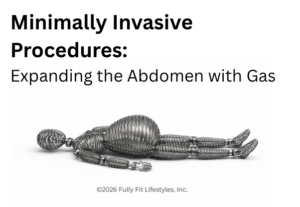
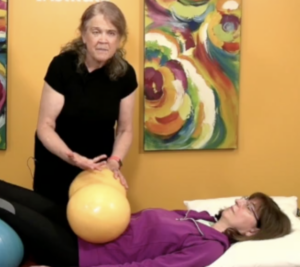
The abdominal muscles were distended during the surgical process. Using compression helps the gas that was used to expand to clear, and provides support to an entire belly full of sore muscles.
A pillow across the abdomen can be supportive, but we find they are often too soft. The peanut balls you see in our videos, when partially inflated, provide uniform support to the entire abdomen. This is hard to achieve with pillows alone.
Supportive undergarments, such as abdominal binders, may also be helpful. Your medical team can be consulted for their specific recommendations.
Stage 2. Once cleared for activity
(often about 6 weeks post-op)
Goal: Begin to reset basic muscle organization between the core and the lower body.
What is happening in the healing process during this time?
The basic tissue of the abdomen is healed but is still fragile. Movement and gentle exercise is helpful to the healing process at this stage of recovery, but too much movement still can feel sore or tight.
How can healing and movement be supported?
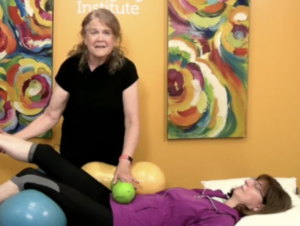
The primary assist in this phase is to support the fragile abdominal muscles while guiding the leg muscles through their basic turns and bends.
The supported integration allows the nervous system to stop protecting since the body is now able now move without causing harm. Protective reactions like this are very real, and were necessary while your body was in the early weeks of healing.
The reset between the core and legs seems so basic, yet it’s an important foundational step that is overlooked and is a game changer to recovering your ease of movement.
Stage 3. After time for healing
(often about 12 weeks post-op)
Goal: Reset complex muscle coordination between the core and the lower body used in larger ranges of motion and more stressful transitions.
What is happening in the healing process during this time?
The body is pretty well healed by this point in time. The more intense movements involving the abdominal muscles are ready to be restored.
How can healing and movement be supported?
Similar to Stage 2, support to the surgical area is used to provide support to the once fragile tissue while also guiding the legs and pelvis through ranges of motion used for larger hip movement (rotating out and extending behind).
VIDEO: The hidden movement disrupters of laparoscopic surgery