

Minimally Invasive Surgery; Kids are Affected Differently!
Each day at the Bridging Institute we see a variety of people with pain and movement concerns.
It’s uncanny how many of them have a minimally invasive procedure in their past. Although the scar is minimal, the surgery is deceptive in terms of how the core muscle coordination can be disrupted.
ESPECIALLY for CHILDREN who are still developing!!!
In this series, we explore why one of the most common types of surgical procedures can create long-lasting stress in the body — often showing up as pain months or even years later.
What we’ll cover in the series:
- Week 1: The procedure — and why it disrupts movement (Link here)
- Week 2: Bridging® support at different points in the recovery process (Link here)
- Week 3: Why the implications for children vs. adults differs
- Week 4: The story of a 14yo who had infant surgery
After Minimally Invasive Surgery …
These are the most common reasons the laparoscopic process is used with children:
- Appendix removal
- Hernia repair
- Duodenal Stenosis repair (stomach)
The clients we meet as children, who have had these minimally invasive surgeries, often have different concerns than adults with pain or limited movement.
Kids often have coordination concerns, including delayed or derailed developmental milestones. They may also have core strength challenges, anxiety, and GI concerns.
Generally, medical follow-up after surgery for kids does not assess:
- How abdominal muscles are coordinating
- Whether core muscles are functioning as they should
- How overall movement patterns may have changed due to compensations
- Which developmental movements and postures may be impacted by the surgery
Just because kids are resilient and recover quickly, does NOT mean their motor skill development recovers! (And these effects can carry into adulthood!)
Key Differences Between Kids and Adults
Following a minimally invasive procedure, the questions we ask about the procedure and its impact upon movement differ between adults and kids.
For adults, we want to know if there were any complications, the locations of the incisions (insertion points), and where the current pain or joint tightness is.
For children there is so much more! In the following sections, I’ll share key points of differentiation and why the details matter so much.
As part of the Bridging® process, the comprehensive details of the procedure, its timing, and the impact on the micromovments of development are each taken into consideration.
The impact of the procedure in future years? YES, THERE IS ONE!
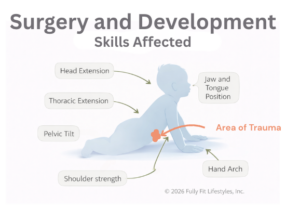 Considerations:
Yes, kids continue to grow after surgery. The scars fade, but the disruption to essential micromovements is real.
Why is the impact on development such a big deal?
Think of the scars and internal disruption as hot glue globs which stiffens as they cool. The ‘glue’ spots have a different tension than the original elastic muscle and skin. As the child grows, these ‘glue’ spots don’t naturally stretch and transition, causing tightness and movement limitations.
Minimally invasive scars are often off-center, which pulls the movement of the core muscles off-center with growth. Some of the ways this can impact kids are:
- Pain or stress at the hip and knee
- A tight shoulder on the side closest to the scars
- Poor abdominal muscle tone
The Bridging assessment takes into account the basic coordination and transitions that can be impacted by the long term ‘glue’ effect of the scars, and gently resets the affected muscle glide and stretch capability.
Timing is everything!
Considerations:
What age was the surgery?
Was it planned or an emergency?
How long were there restrictions for recovery?
Why is the timeline important?
The age of the surgery gives us an approximation of which discrete developmental micromovements may have been skipped or skewed due to the disruptive nature of any surgery and recovery.
If the surgery was planned, then an issue was known beforehand. This becomes a clue that there may have been movement and positioning restrictions for the child before surgery. The preceding micromovements need to be assessed.
Recovery can be more challenging
Recovery is a period where we are often advised to be still, so we don’t pull on stitches or tear a fragile repair. Complications mean there is more attention paid to the micromovement of the core, specifically in the area of the scars. Kids being kids can be more challenging.
Considerations:
- Where there any restraints during recovery?
- Any complcations?
Why is the recovery activity a factor to consider?
As adults, we know to take it easy and let our bodies heal. Kids are generally going to move around, whether we want them to or not. The movement can cause the muscle coordination of the abdomen to pull off-center which negatively impacts coordination.
Again, the Bridging assessment checks to make sure movement is centered, and that movement of the core links properly to the arms and legs.