
Ankle Sprain: Healed, but Still Unstable??
Ankle sprains. Are you like our clients who have …
- Misstepped coming off a ladder, or
- Taken a step forward toward the pickleball net, but your toe caught and your ankle buckled, or
- Looked away when walking such that one foot ended up off the sidewalk, turned and collapsed, or
- Tripped over the dog when it stopped suddenly?
These are just a sample of the stories behind the ankle sprains we’ve worked with. Some of the injuries happened recently. Some happened years ago, yet were still nagging.
Read on for Sue’s story, and to learn more about how regaining ankle function after a sprain can often require more than time and exercise.
Sue, Pickleball, and Her Ankle
She was in our office for a tune-up related to her prior hip and low back pain, caused by her C-section scar tension. It had been a good six months since we had seen her, and those muscle resets were holding up for longer each time. 🙂
Sue also wondered if there was anything I could do to improve her ankle that she sprained last year when her foot caught going for a shot while playing pickleball. She had done all the things recommended for recovery but it still felt unstable and she had to tape it daily.
What had she already tried?
Initially it was rest and ice, then a boot for 6 weeks. Her ortho referred her for Physical Therapy exercises which helped restore mobility. Gradually, she eased back into activity and back to pickleball. Still not feeling steady, she did another set of physical therapy sessions.
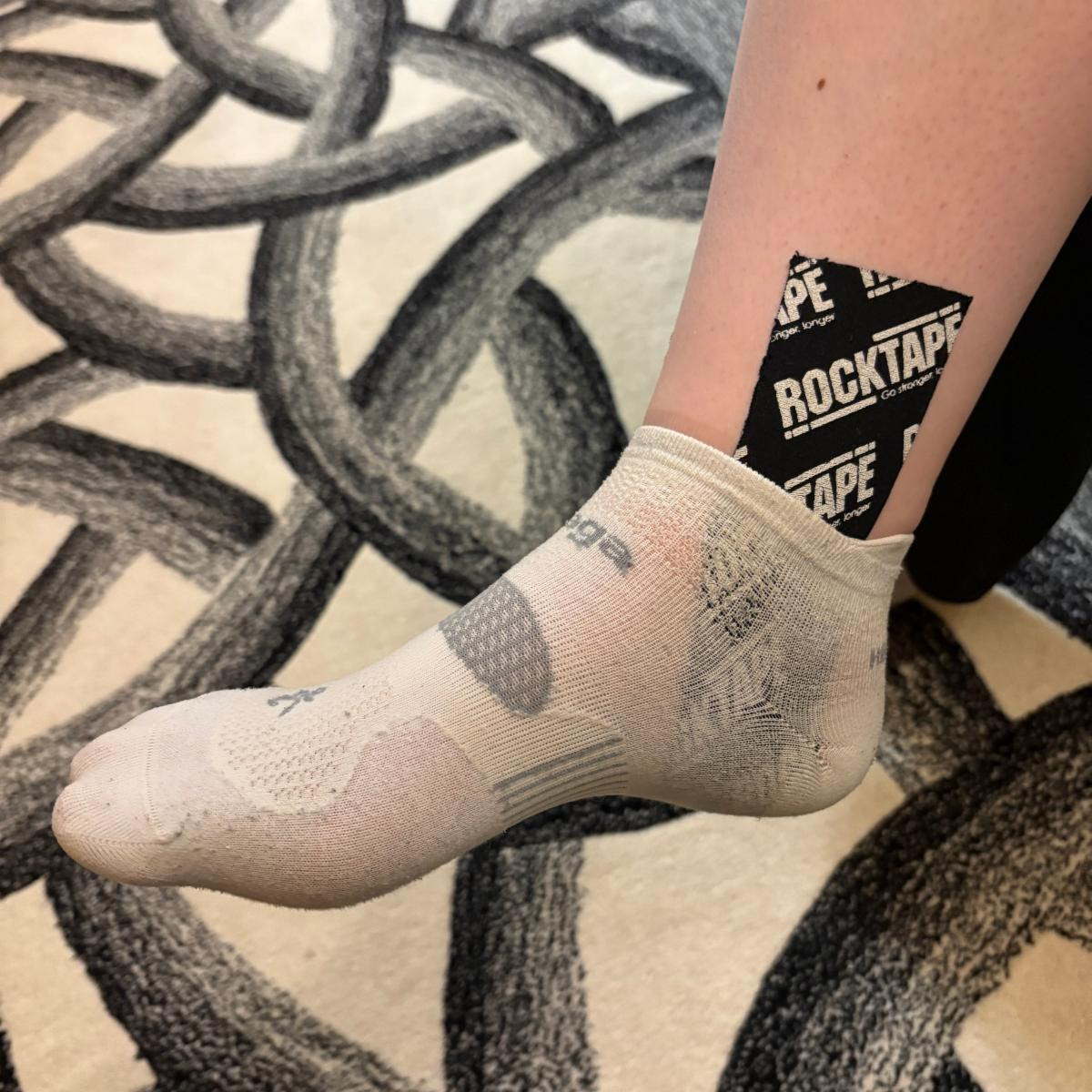
The primary thing that helped was the way her physical therapist taped her ankle using kinesio-tape, often referred to as K-tape.
She still did the ankle exercises daily and was back to playing pickleball, but always felt the nagging sense that her ankle might give out again.
Could a Bridging® reset help?
Yes! Her ankle benefitted from support to the sides, matching up and resetting the muscle coordination, which allowed for a smooth flex and extend motion. Sue was amazed when she tested all sorts of movements after our session. Her ankle and leg moved in ways they hadn’t since the injury. She was so excited for her next pickle match!
Ankle Basics
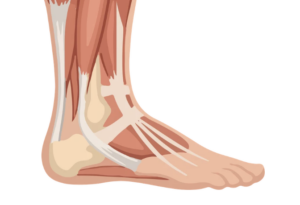 To better understand why regaining stable ankle function after a sprain can be a challenge, let’s look at how the muscles interact in the most common sprain — the foot rolling onto the outer side.
Which muscles are affected, and how? In general, the muscles on the outer edge of the foot/ankle, named the peroneals, also known as the fibularis, connect to the lower leg. Their primary job is to stabilize the foot as it naturally shifts when you land on the ground.
When your ankle rolls, the peroneals become over-stretched, which causes them to lose their coordination with the muscles on the other sides of the ankle. The ankle has an interesting balance of muscles on the front, back, and outside, not the inside edge. Those are mostly tendons and ligaments.
What about the ligaments? Yes, a true ankle sprain is defined as injury to the ligaments of the ankle. Ligaments connect the little bones of the foot together while allowing for a slight amount of movement.
What else happens in a sprain? Often the ligaments are stressed and twisted. The peroneal muscles are stretched and twisted. All of this shifting causes the muscles on the front and back of the ankle to lose their coordination too.
Stable under normal circumstances, but when it’s sprained …
This construct makes for a very stable configuration under most scenarios. However, that same stability also makes it hard to piece together the structural function on its own.
Think of it like getting the last corner of the fitted sheet on a deep mattress — you have to maneuver it just right to get it on. Exercise alone misses the ability to get the sheet and mattress perfectly back together.
What Does Exercise Miss?
When searching for recommendations for recovery, you will find links to any number of ankle exercise videos. The goal of these exercises is to supposedly ‘strengthen’ the ankle again.
Your question should be, how do they strengthen the ankle when the muscles don’t even coordinate with each other correctly? Exactly. The muscles do their best, but you’re actually exercising and strengthening a compensational way of the muscles working together.
How do all the muscles and connective tissue get realigned and reset?
By exercise — no. By Bridging — yes!
To reset the coordination of all the various structures, we find it necessary to gently guide and support the ankle and leg in the position of the injury to allow restoration. Almost like rewinding a video to right before the injury occurred, so the structures are in the position where they last have memory of working together.
Once the lateral movement (side to side) is reset and stable, the flex/extend and turning motions of the foot also have to be intentionally recentered and reset.
Exercise alone will not allow the individual structures to match up and work together properly again.
Thoughts for Your Movement/Therapy Professionals
Recovery Gaps After Ankle Trauma
🟥 Injuries (ankle strains and sprains)
Suggestions for therapy and movement professionals
If your client/patient had a bad ankle sprain, here are some steps to consider:
1. Assess! Support the entire heel and ankle area in your hand. With a soft touch, allow the ankle to turn or twist finding the position where the structures (muscles and connective tissues) feel like they naturally shift in a certain direction. Where do they want to go, not where should they be going. This is likely the direction and position of the injury.
2. Hold. Patiently and gently hold the ankle structure at the end range of the posistion identified above. You should feel slight shift as the muscles and ligaments begin reconnecting with each other. Shift the position in order to maintain a light muscle tension as the process of resetting progresses. Repeat a couple more times. The foot should reposition to center and be able to flex and extend with a little guidance.
3. Test out movements in different leg configurations such as side lying and prone (stomach lying). The changes in hip and knee orientations influence the ankle function. You may need to repeat step 2 in these alternate positions to fine-tune the ankle alignment to allow for smoother, stable movement.
4. Test and refine all of the ankle movements with a closed chain foot position to make sure the connection to the ground is also stable.
Taking each of the above into account allows the impacted muscles to relax and reorganize more quickly, and can guide you to a more complete improvement in balance.
If you’re interested in learning the Bridging muscle resets to better help your patients after injuries, there is a new cohort kicking off in February 2027 and you can join the waitlist here.