
Side-swiped or Rear-ended? Your Pain (and Relief) is Unique to the Details
Auto accidents seem to be a theme in the office lately. A couple of the accidents were rear-end variety, and just today, a side-swipe from the passenger side. Our clients were the driver in each scenario.
After each incident, these drivers were shaken up, but, by most measures, appeared to physically be ok.
Until the nagging pain in the shoulder, the chronic tight neck headache, and unrelenting pain in the hip just wouldn’t clear up. No amount of stretching, massage, red light, or exercise moved the needle. Nope, no help from their Theragun either.
They had tried ALL the things, yet were still struggling!
These clients were so surprised to discover how their pain and inflexibility could change so much in the first session of Bridging®! The perplexed, yet amazed, look from the client at the end of their session is one we’ve grown accustomed to seeing.🙂
How could this be when their other options had barely made a dent.
Taking the time to figure out the specific cause of the pain makes ALL the difference.
Read on to learn more about our process for finding the actual micromovement gaps needing support. Often these muscles have been waiting for support. Once supported, they reset quickly!
Auto Accidents. Why do the details matter?
- Side-swipe versus rear-end?
- Passenger versus driver?
- Hand position used when driving?
- Did you see the on-coming vehicle before the hit?
- Did the vehicle spin? Or hit any other structures after being hit?
This is the common list of our questions in the Bridging® Institute office as we begin our ‘post-game’ analysis of your event.
What we are trying to understand about the accident:
- The relative position of the body and the vehicle structures when the impact occurred.
- The location and direction of forces acting upon the body.
- The location of stabilizing structures, such as seatbelts and center consoles.
- The location your head was directed (forward or toward the mirror).
- The location of your elbows and the orientation of your wrists (side, overhand, or underhand).
The answers to each matter, because they paint the picture of how your body structurally absorbed the impact of the event. Each event is experienced uniquely, and the after-effects are just as unique.
Yes, all the forces and orientations matter
The architecture of the body is built to absorb force from the ground upward when walking and jumping. Forces absorbed in an accident are not from the ground up, and are often in multiple directions.
The forces are dissipated in pathways through the muscles and bones in the craziest directions. This causes mayhem in the body because the structures are shifted in very disjointed ways.
Detective work requires thinking through where the impact forces all ended up. Those end up being your tight and painful areas!
To help analyze, we construct a diagram of how your body had been compressed and/or torqued with each force from the event. This becomes your unique roadmap for resets, and recovery.
“If the issues are from the accident, why isn’t my body telling me?”
A quirk about sensory receptors comes into play when your body is compressed or torqued in such a way that the muscle and joint micromovement is jammed. There is no source of movement triggering feedback to your brain to signal that something is off. The jammed area can’t provide feedback.
You only realize how jammed up the area was when the muscles finally relax and move. This is what happens with the support in the Bridging muscle reset process.
What are these impact ‘forces’?
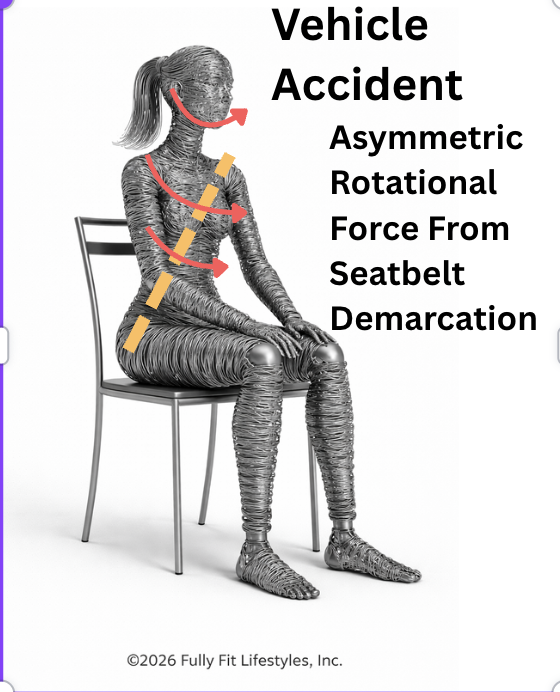
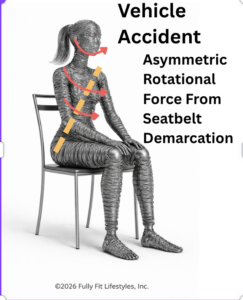 The image shows common forces experienced by a driver in a vehicle when rear-ended. This includes:
Torque to the neck muscles due to asymmetric restraint.
Torque to the right side chest muscles from that side being being unrestrained.
Compression to the hip and/abdomen from being thrust against the lap belt.
Compression coupling force at the top of the left shoulder from sandwiched forces–from the hit (rear) and from the restraining system locking in (front).
Also common are elbow and wrist torque due to compression between the steering wheel and seat thrusting forward.
The right ankle and knee can also torque and compress if there is enough force to push the seat forward.
How do all of these areas get ‘fixed’?
Your personal trainer or physical therapist might want to massage or cup each of these impact zones to help release the micromovements. In theory, this seems like a great plan!
In reality, it’s not how the body works. What we’ve discovered is that unjamming and untorquing requires creativity and patience. Why?
- Positioning matters: Your body was jammed while in a specific configuration. It is best able to unjam in a reasonably similar position. If you think of this as muscle memory, you need to re-create the event memory before you can clear it away. This step often requires creativity to keep things safe, yet effective.
- Support is needed at just the right angle and location: Each of these impacts affected a localized zone. You have to keep the support specific to the zone.
- Push-in to pop-out! Just like a child-lock top, the compression in the body is actually a screw-type torque. To unjam, a rotational push force is usually what allows the jam to expand and clear.
- Reorganize with the rest of the body. Although free to move, the affected muscles have lost their bearings. Specific movements need to be guided to refresh and reintegrate the left and right sides of the body to each other. The upper and lower body coordination, and the core to the limbs also need a refresh. It goes quickly, yet is a necessary step.
Need more help from your trusted provider? Share this newsletter and the tips that follow.
Thoughts for Your Movement/Therapy Professionals
Recovery Gaps Identified from Vehicle Accidents
🟥 Injury (vehicle accident)
Suggestions for therapy and movement professionals
If your client/patient has been in an auto accident, there are still residual compressive and torque injuries to resolve. Here are some steps to consider in formulating a action plan:
1. Map out the points of compression and the force lines. Directionality makes a difference! You can rationalize most of these, and your patient can fill in the specifics unique to their story. There is ALWAYS a story.
2. Support areas of force in the direction of the force. A tennis ball is often a great prop to support a targeted zone that encountered intense force. You often have to push and twist inward to decompress movement at a joint.
3. Small oscillatory movements will help decompress easier than forceful ones. Think of very gently ‘shaking it out’ in the specific area of injury.
4. Micromovement reintegration of the affected areas. Move each side of the body until the ease and range match. Add arm and leg movement to increase complexity. You want to do these with slow speed and low intensity to allow the nervous system to reprogram. Once the range of motion and ease are symmetric, increase the power.
Taking each of the above into account allows the impacted muscles to relax and reorganize more quickly, and can guide you to a more complete resolution of pain and tightness.
If you’re interested in learning the Bridging muscle resets to better help your patients after injuries, there is a new cohort kicking off September 9, 2026. All the info is on the website here.